
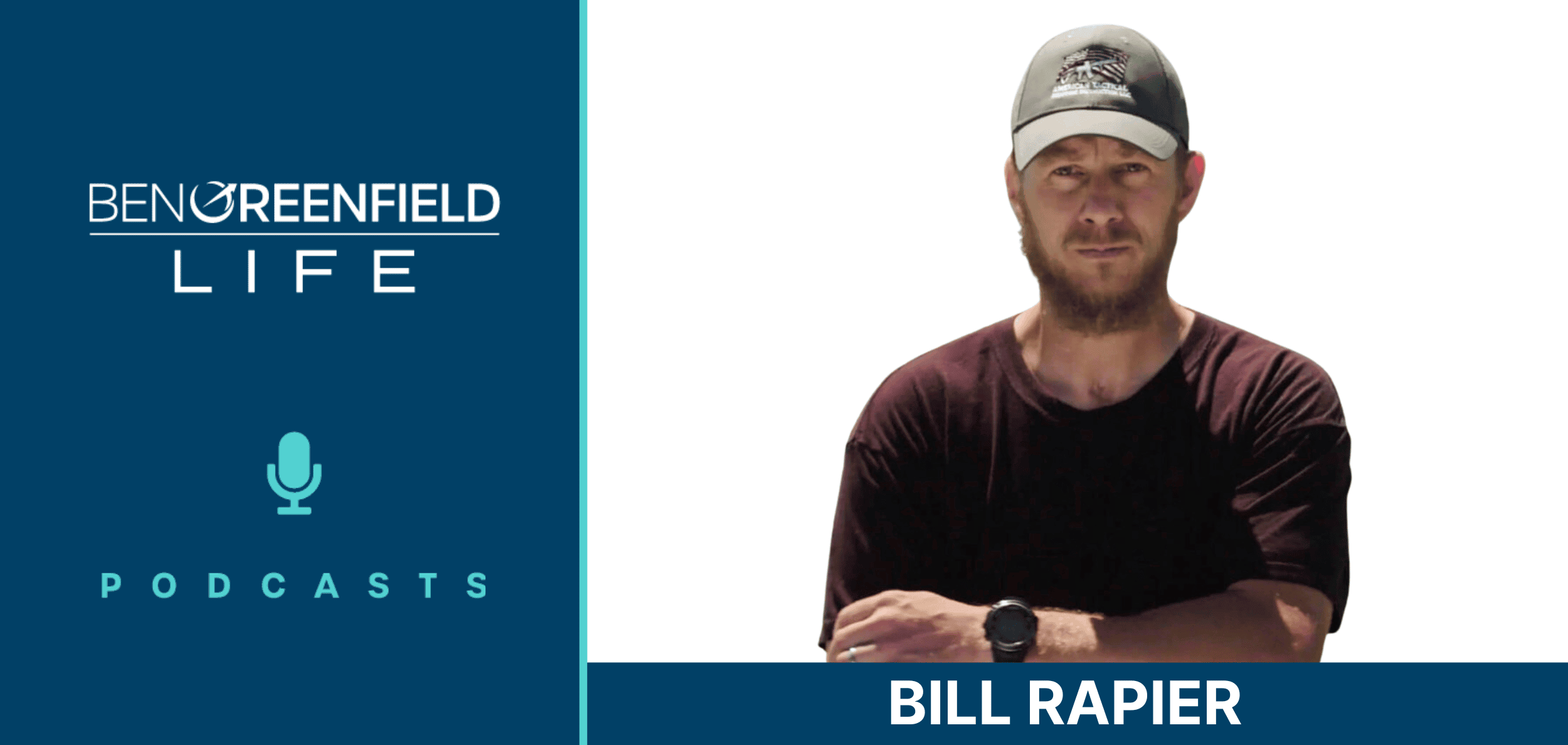
Should YOU Carry A Gun & Knife To Protect Yourself? Self-Defense & Protection 101 With Navy SEAL Turned Preparedness Expert Bill Rapier.
Reading time: 7 minutes
What I Discuss with Bill Rapier:
- The gear Bill carries every day, and how holsters, smart placement, and a tactical mindset keep it all safe, hidden, and ready if needed…02:33
- Why carrying weapons isn’t about fear but about violence insurance, how awareness and de-escalation come first, and how real preparedness is knowing when to step back, speak up, or act first…08:15
- How real violence is rare but does happen, why the most trained people are the least likely to seek fights, and the disturbing reality of church shootings…14:15
- His path from a missionary kid in Germany and Africa to becoming a Navy SEAL, serving 14 years at DEVGRU with multiple deployments, and starting a family after his military career…21:30
- Teaching kids safe firearm habits early, how he and his wife approach carrying, and why consistency and safety matter as much as the weapons themselves…25:18
- How beginners should start with quality equipment and proper safety training, why awareness and dry fire practice matter more than fancy gear, and how consistent reps build real proficiency and confidence…33:45
- Why true martial skills include more than guns, how Kali systems teach practical blade use, why jiu-jitsu is valuable but slow to learn, and how fast transitions between weapons matter when fights get chaotic…44:12
- The biggest myths people believe about self-defense, and why real preparedness looks very different than what most expect…48:30
- His journey of faith and how it ultimately shaped his life as a devoted husband, father of seven, and elder in his church…52:21
- How his training courses help people start with practical pistol skills, and how his new online program makes this kind of training accessible anywhere…58:53
- Why awareness matters in everyday life, why real safety comes from personal preparedness, not politics, and how training can end up saving lives in surprising ways…1:03:40
In this powerful conversation with Bill Rapier, you’ll discover both the practical and philosophical sides of self-defense, preparedness, and living with vigilance and intention. Bill—a former Navy SEAL and founder of Amtac Shooting—shares not only his deep expertise in firearms, blades, and integrated combatives, but also the mindset that will help you train responsibly and live ready.
You’ll learn why carrying tools like firearms and knives is less about aggression and more about having “violence insurance”—a rare but critical safeguard for protecting yourself and others when it truly matters.
As you listen, you’ll also get clarity on the nuts and bolts of everyday carry: what to carry, how to conceal safely, and why it’s important to train both your strong side and your “other strong side.” Additionally, you'll gain insights into how small shifts in language and mindset can dramatically change the way you prepare for scenarios where decisive action could save lives.
If you’re raising a family, you’ll hear Bill’s thoughtful approach to teaching kids about firearms and blades—rooted in respect, discipline, and age-appropriate lessons. You’ll also pick up strategies for introducing these topics to a hesitant partner and creating a family culture of stewardship and care, not fear or bravado.
Bill will show you how carrying tools actually increases your responsibility—to stay fit, think clearly, and keep your skills sharp through consistent, intentional practice. From dry-fire training to jiu-jitsu and blade work, you’ll learn what it takes to train effectively and realistically.
Please Scroll Down for the Sponsors, Resources, and Transcript
Episode Sponsors:
MASA Chips: Introducing the best guilt-free snack on the market: classic, seed oil-free tortilla chips with only 3 natural ingredients. Go to masachips.com/greenfield and get 25% off your first order!
Quantum Upgrade: Recent research has revealed that the Quantum Upgrade was able to increase ATP production by a jaw-dropping 20–25% in human cells. Unlock a 15-day free trial with the code BEN15 at quantumupgrade.io.
Ketone-IQ: Ketones are a uniquely powerful macronutrient that can cross the blood-brain barrier and increase brain energy and efficiency. With a daily dose of Ketone-IQ, you'll notice a radical boost in focus, endurance, and performance. Save 30% off your first subscription order of Ketone-IQ at Ketone.com/BENG.
Seatopia: Seatopia delivers lab-tested, sushi-grade seafood that’s verified to be mercury-safe and free from detectable microplastics. Frozen at peak freshness, you'll receive the benefits of super nutrients like EPA, DHA, selenium, zinc, and vitamin D. Right now, you can save 15% on your first box and get a FREE 1:1 chef-led cooking class to kick-start your journey to cooking gourmet seafood at home by going to seatopia.fish/ben or by using code BEN at checkout.
LMNT: Everyone needs electrolytes, especially those on low-carb diets, who practice intermittent or extended fasting, are physically active, or sweat a lot. Go to DrinkLMNT.com/BenGreenfield to get a free sample pack with your purchase!
Resources from this episode:
- Bill Rapier:
- Podcasts:
- Other Resources:
- Kydex Holsters
- Sheepdog Response (use code BENGREENFIELD for 10% off)
- Kali
- Sayoc Kali
- Atienza Kali
- Grace to You
- Doug Wilson
Ben Greenfield [00:00:00]: My name is Ben Greenfield, and on this episode of the Boundless Life podcast.
Bill Rapier [00:00:05]: It's a form of violence insurance. It allows you to be the guy with the answer if you are faced with a problem where the correct answer is violence.
Ben Greenfield [00:00:15]: Welcome to the Boundless Life with me, your host, Ben Greenfield. I'm a personal trainer, exercise physiologist and nutritionist. And I'm passionate about helping you discover unparalleled levels of health, fitness, longevity and beyond. I have no clue if this is even like a rude question or, or a. No, no question in, in, in your field, but are you carrying weapons right now while I'm talking to you?
Bill Rapier [00:00:47]: Absolutely.
Ben Greenfield [00:00:49]: How do you explain that to people? Like, like. Well, first of all, I'm actually curious what, what you're carrying on your body and why.
Bill Rapier [00:00:57]: Okay, so just to start off, I've got a steel frame compact Walther PDP on me. So I've got 18 rounds on the gun or in the gun and I've got another 18 in the pocket.
Ben Greenfield [00:01:07]: For people who don't know what that. That's basically a handgun.
Bill Rapier [00:01:09]: Yes, I've got a handgun. Yeah. I've got a pistol on me strong side and a black point holster. And then I've got a so and then I have a full reload as well. So I've got another. So I've got 18 rounds in the gun. I've got another 18 rounds in my pocket. And then I have a,
Ben Greenfield [00:01:25]: So, the 18 rounds in your pocket, that's what you call like a mag.
Bill Rapier [00:01:28]: That would be a magazine.
Ben Greenfield [00:01:29]: Yep.
Bill Rapier [00:01:30]: And then I would have. Or I do have a Northman.
Bill Rapier [00:01:34]: Right.
Bill Rapier [00:01:34]: So one of the, one of our blades basically more like tool like for, for that one. We live on a farm, so you know, you need to be able to cut stuff.
Ben Greenfield [00:01:42]: Yeah.
Ben Greenfield [00:01:42]: So I want, I want to hear about that later on how you made. So when you say one of our blades, you actually make blades?
Bill Rapier [00:01:48]: Yes, yeah, so. So I have that in my right pocket and then opposite my pistol I've got a little bit bigger blade. That's what we call the other strong side blade. And that is so that I can deploy a lethal tool with either hand. And it, it makes. Without going down too many rabbit holes, it makes you an order of magnitude harder to deal with if you can deploy a lethal tool with either hands.
Ben Greenfield [00:02:09]: So when you say strong side like for as you're right handed person, then when you say other strong sides, basically your left hand.
Bill Rapier [00:02:16]: Yeah, so it's. Basically it's, it's, it comes from Siak Right. I didn't make this up. But the idea is so many people in industry, they'll say strong side and weak side. And just if you're talking about fighting and we shouldn't be calling ourselves weak.
Bill Rapier [00:02:30]: Right.
Bill Rapier [00:02:30]: For theJiu Jitsu guys, the coach never says, hey guys, let's warm up with 50 strong side arm bars and 50 weak side arm bars.
Ben Greenfield [00:02:37]: Right.
Bill Rapier [00:02:37]: He just says, give me 50 arm bars on each side. Yeah, Right. So the way we talk to ourselves is important. Therefore strong side, other strong side. As to the why.
Ben Greenfield [00:02:48]: Oh, and one other thing. When you just described everything that you have in your body, a lot of people are listening to this at the gym. They aren't necessarily watching the video of you and me sitting right here. People can't see any of this. You're just basically wearing a button up shirt. And this is all underneath your shirt.
Bill Rapier [00:03:07]: 100%. You should be concealed. So the things that will help you to win, speed, surprise and violence of action.
Bill Rapier [00:03:13]: Right.
Bill Rapier [00:03:13]: We don't want to give any of those up if we don't have to. So while, you know, I live in Idaho as well and love the fact that people will open carry and no one freaks out when, you know, when.
Ben Greenfield [00:03:26]: Someone'S open carry means you can see.
Bill Rapier [00:03:28]: It, you're exposed, Carrying. Yeah. Cowboy revolver. Cowboy.
Bill Rapier [00:03:33]: Yep.
Bill Rapier [00:03:33]: Or shoot, I've seen guys on motorcycles with drop leg holsters with DOT guns in them, which is pretty cool for Idaho. It's a great political statement. It's a horrible tactical decision for all the people that I train, all the people within our church community, within the tribe. I say let other people do that. We should keep it as a surprise because you cannot be on all the time. You cannot be guarding your tools all the time. You know, just think you're at the grocery store and you're reaching up to grab something. Your weapons retention is not there.
Ben Greenfield [00:04:05]: Yeah.
Bill Rapier [00:04:06]: So great political statement, but don't do it concealed.
Ben Greenfield [00:04:10]: There's some people who are kind of technicians and they're still wondering how all this works. When you're carrying a gun like that on your body, do you carry it like on your hip? Is it just shoved down the front of your pants? Or how do people do stuff like this?
Bill Rapier [00:04:23]: So best practice is you're carrying it in an all Kydex holster either on your strong side.
Bill Rapier [00:04:29]: Right.
Bill Rapier [00:04:29]: So for me it's 3 o' clock or actually slightly 4 to 3 o' clock or appendix. That's kind of the. Those are the kind of the two industry standards. Definitely you want it In a holster it would be unsafe to have around in the chamber. And just.
Ben Greenfield [00:04:44]: Does a holster do a better job ensuring that, that there's not an accidental trigger pull?
Bill Rapier [00:04:49]: Absolutely. Well, if you, if you have a quality holster, which is why, you know, we, we clarify that on our Kydex. Kydex, yeah. It's just a moldable plastic.
Ben Greenfield [00:04:58]: Okay. So that's not the brand. That's, that's a style, that's, that's a.
Bill Rapier [00:05:02]: Style of holster as opposed to like a leather holster or a hybrid holster that maybe would have leather on one side and Kydex on the other. We just want all Kydex a good holster. It's not. Your holster is never touching the trigger ever. And it's also protecting your trigger completely. So there's no way that if someone was just grabbing at you, they're not gonna make the gun go off.
Ben Greenfield [00:05:24]: Yeah. And for all like the Game of Thrones fans out there, like, do you have some kind of like a sheath, a scabbard for your, for the blade, for your Northman?
Bill Rapier [00:05:32]: Yes, absolutely. So we, we have, well, we've got a bunch of different types, but we kind of differentiate between either a pocket carry blade. So that's going to be, there's going to be less of it exposed, right. Just the very last three quarters of an inch or so of the back of the blade of the handle is going to be exposed. And that's so that because it's just sitting in your pocket, right. So you can just reach in and grab the thing and pull it out. And then the other style would be a belt style sheath and that goes on your belt. And you're going to have more, you're gonna have your whole handle exposed.
Bill Rapier [00:06:06]: So it's going to be faster as you're drawing it because the whole handle is exposed and you can get away with it because it's underneath your shirt.
Ben Greenfield [00:06:13]: Okay, got it. So kind of like I was alluding to earlier, a lot of people are going to wonder, well, why the heck would you even do this? Like, you know, why would you look like Rambo underneath your button down top? You know, super important living in good old America.
Bill Rapier [00:06:30]: Yeah.
Ben Greenfield [00:06:30]: You know, it's safe out here.
Bill Rapier [00:06:31]: So super important question. So. Yes, safe out here.
Ben Greenfield [00:06:35]: So.
Bill Rapier [00:06:35]: Right.
Bill Rapier [00:06:36]: We're in the general vicinity of Moscow, Idaho and we know that nothing bad ever happens in Moscow. Like someone breaking into your house in the middle of the night and stabbing multiple people to death.
Bill Rapier [00:06:45]: Yeah, right.
Ben Greenfield [00:06:46]: Which is exactly what was looking at it on the news last night.
Bill Rapier [00:06:50]: That just happened Just, yeah, they finally just threw the bucket, the guy. So it's not a fear based thing. It's a, you have car insurance not because you think you're going to get in a wreck, but because it's probably a good idea to have. You have fire insurance on your house. Not because you expect to have a fire, but in the unlikely event that you do have a fire, man, it sure is nice that someone will actually come in and rebuild your house for you afterwards. So I look at, you know, having awareness, carrying tools and knowing how to use your tools is just, it's a form of violence insurance.
Bill Rapier [00:07:28]: Right.
Bill Rapier [00:07:28]: It allows you to be the guy with the answer if you are faced with a problem where the correct answer is violence.
Bill Rapier [00:07:37]: Right.
Bill Rapier [00:07:37]: And obviously that's, we don't want that to be the answer.
Bill Rapier [00:07:42]: Right.
Bill Rapier [00:07:42]: I always say that it's a higher level win to win with a lower level of violence. And the highest level win is just zero violence.
Bill Rapier [00:07:50]: Right.
Bill Rapier [00:07:50]: So if we go down that train a little bit, if you know that bad things happen in a certain part of town, don't go to that part of town.
Bill Rapier [00:07:55]: Right.
Bill Rapier [00:07:55]: That would be the highest level win. The next level win might be you have to go into that town for whatever reason. You're walking down the street and you see there are some people that you think might be a problem for you. And so instead of having to walk directly past them, you cross the road and you, you walk past them on the other side. Again, we've created distance.
Bill Rapier [00:08:14]: Right.
Bill Rapier [00:08:14]: That would be the next level win. Then the next would be just being man enough to look people in the eyes.
Bill Rapier [00:08:19]: Right.
Bill Rapier [00:08:19]: As you, as you are.
Bill Rapier [00:08:20]: Right.
Bill Rapier [00:08:21]: If you're, if you're the person that's super timid and you're looking down and you're like, man, if I just don't look at him, he'll go away. Well, that's actually what a lot of criminals are looking for, is weak people.
Ben Greenfield [00:08:31]: Sign of weakness.
Bill Rapier [00:08:32]: Exactly. So just being, you know, having confidence to look at someone say, hey, you know, how's it going?
Bill Rapier [00:08:36]: Yeah, right.
Bill Rapier [00:08:37]: Like that. That's another.
Bill Rapier [00:08:38]: Right.
Bill Rapier [00:08:39]: So that would be the next level win. Then the next would be if you're, you know, 99% sure that this guy is going to do violence against you, go first.
Bill Rapier [00:08:48]: Right.
Bill Rapier [00:08:49]: Don't wait. Because especially, you know, as we, as we start training more, go first, go first.
Ben Greenfield [00:08:54]: Is that so? So this will confuse some people. And you know, I would imagine some people under the impression that if you go first, that means you attack somebody.
Bill Rapier [00:09:03]: Yeah. So it's really important. You know, it's a little bit more of a nuanced approach here. So when I say go first, this is after I've already attempted to de escalate, right? So, so picture this. You're walking to your car. You know, you're parked at your grocery store. It's late at night, Someone starts approaching you from. And you, you pick it up from, you know, 30, 40 yards out.
Bill Rapier [00:09:25]: You see the guy, he's walking directly towards you. Maybe he gets 20 yards out and you say, hey, how's it going, man? You know, good evening, how are you?
Bill Rapier [00:09:34]: Right?
Bill Rapier [00:09:34]: And the guy is just like, you know, has, has a look about him, right? Maybe he's saying crazy things. He continues coming towards you and then, right, we can escalate things now with words. Oh, hold on, man. Like you're kind of creeping me out.
Bill Rapier [00:09:48]: A little bit, right?
Bill Rapier [00:09:48]: Hold on. Stop right there, right? Then you can stop, right? We can escalate things a little bit with words while we're doing this. We don't have to be static, right? We can move. And you're in a parking lot. Put another vehicle in between you and your potential threat, right? And now talk to the guy. Hey, what are you trying to do, man? You're creeping me out right now. Like, are you trying to rob me?
Bill Rapier [00:10:07]: Right?
Bill Rapier [00:10:08]: Have this conversation while we're still at distance.
Bill Rapier [00:10:10]: Yeah, right.
Bill Rapier [00:10:11]: And then you get to the point where now he's on the other side of the vehicle from you and he's like running around the car to try and get at you. Well, that's abnormal behavior, right? The guy you've attempted to de escalate to discern what's going on, to diffuse this whole thing, but now he's right, and we've had a conversation and now this guy's like chasing you around the car. Go first, right? And that could be an elbow to his face.
Ben Greenfield [00:10:37]: Wave at the mall cop, get him.
Bill Rapier [00:10:39]: Over there, you know, I mean, if the coppers are there, absolutely. Hey, buddy, could use a hand over here, you know, let those guys do their job for sure. But if that guy's not there then either, right? If there's no tools, I'm not going to use tools, right? So hands get hands, tools get tools, right? That's really important.
Ben Greenfield [00:10:57]: You mean you don't escalate the level of violence to a level that's higher than what that person has come out using for sure.
Bill Rapier [00:11:03]: Well, again, me being, being, you know, a capable middle aged man now, right? Like, whereas if I was 80 years old and a 20 year old kid is coming up and, and trying to get in a fistfight with me. I probably would go to toys or.
Ben Greenfield [00:11:21]: If let's say you were a woman and some guy comes out with a knife.
Bill Rapier [00:11:23]: 100% pull your gun. Well, I mean if, if anyone comes at me with a knife, I'm immediately pointless. Okay, 100.
Bill Rapier [00:11:29]: Right.
Bill Rapier [00:11:29]: That you will absolutely get yourself killed trying to just.
Ben Greenfield [00:11:32]: So there's not levels of tool, you're saying just the presence or absence of a tool would dictate he's coming at me with a steel pipe matter what.
Bill Rapier [00:11:39]: It is, my tools are coming out. If he has a knife in hand, my tools are coming out. He's got a gun in hand, my tools are coming out.
Ben Greenfield [00:11:44]: Got it.
Bill Rapier [00:11:45]: But if he's just.
Ben Greenfield [00:11:45]: So if you're standing there with a gun, he comes at you with a piece of plywood, you don't not pull your gun because you don't have a piece of plywood.
Bill Rapier [00:11:50]: Yes.
Ben Greenfield [00:11:50]: Yeah.
Bill Rapier [00:11:51]: Right.
Bill Rapier [00:11:51]: We don't have to go down to his level and say hold on while I go to Home Depot and get a piece of plywood and we can have a match with plywood. Yeah. No, no. Hands, get hands. Tools get tools. It's always a higher level win to win with a lower level violence or zero violence.
Ben Greenfield [00:12:07]: Yeah, yeah.
Ben Greenfield [00:12:08]: Okay. So how much of this is a hypothetical? The reason I ask that is some people are probably still wondering, well, yeah, that sounds like it'd be a good idea, but does this stuff actually happen? I mean, you gave the example of the stabbings that tragically occurred in Moscow. What about like, like you, have you ever run into a situation in which you've had to deal with something like this or de escalate a scenario?
Bill Rapier [00:12:34]: Not in con US.
Bill Rapier [00:12:36]: Right.
Bill Rapier [00:12:36]: I mean, overseas, you know, obviously we were, that was our job was to go do violence and.
Ben Greenfield [00:12:41]: Yeah.
Ben Greenfield [00:12:41]: How about one of your students or somebody you've worked with where this stuff.
Bill Rapier [00:12:44]: We have had, we have had some guys, we've had some cops that have shot guys after training. So yeah, I mean it is something that happens. Fortunately, it doesn't happen that often. And honestly the, the guys that I know that are the most dangerous are actually the least likely to get into a violent situation because they recognize the severity of it.
Bill Rapier [00:13:07]: Right.
Bill Rapier [00:13:07]: If you're carrying tools, it's that much more important that you don't get in a fight. So like overwhelmingly, the guys that I train aren't guys that are going to bars and getting nine eyed and going out and getting in fights because like you're, you're just like your, your life is going to go downhill very, very quickly if that's what you're doing right there. So generally the guys I'm teaching are a little bit more mature, you know, have thought things through a little bit more. They're not in that phase of life where they're, you know, going out bar hopping and getting in fistfights with people.
Ben Greenfield [00:13:42]: You're not in scenarios where this would have a high likelihood of happening.
Bill Rapier [00:13:45]: Yeah.
Ben Greenfield [00:13:45]: You brought up a church. You know, I've thought about this. Sometimes when I'm sitting in church, we have security guards in our church. I know you go to church also. Has this happened in America, for example, at churches where weapons have been pulled or people who are trained need to help?
Bill Rapier [00:14:02]: In the Midwest, just recently a guy started shooting from outside. I believe he was using an AR and just started shooting into the building. Another one of the, I think one of the deacons was driving in and actually ran the guy over as he was shooting at the church. And then one of the church security guys ran out and burned the guy down.
Ben Greenfield [00:14:22]: Wow.
Bill Rapier [00:14:22]: Yeah, like went and shot and killed the guy. So, I mean there's, you know, unfortunately, church shootings are becoming something that are happening several times a year now. I mean, I think of that.
Ben Greenfield [00:14:34]: I don't know if it's anything specifically with religious or anti religious zealots in America, as much as it might just be, that's another place where, you know, people are going to be publicly gathered and, and open to being wounded or assaulted.
Bill Rapier [00:14:46]: And a lot of churches still don't have church security teams and so they think it's going to be a soft target.
Ben Greenfield [00:14:53]: So I met you through an organization called Amtac where you actually train people. And I want to hear a little bit more about that. But before that, I really didn't even introduce you yet. You have a last name. Do you pronounce your last name Rapier?
Bill Rapier [00:15:09]: I do.
Ben Greenfield [00:15:10]: Okay. Doesn't that mean like spear or sword? Spear person.
Bill Rapier [00:15:14]: Sword.
Ben Greenfield [00:15:16]: Did you choose this profession based on your last name or is that just coincidence?
Bill Rapier [00:15:21]: It's cool.
Ben Greenfield [00:15:21]: Coincidence.
Bill Rapier [00:15:22]: It's the way God made me.
Bill Rapier [00:15:23]: Right.
Bill Rapier [00:15:23]: I mean, this is, I've got pictures of me being, I don't know, five or seven years old with a beard painted onto my face and an OD green jacket and a beret on and a non functioning shotgun in my hand. And. Yeah, it's just, it's. I've always wanted to do something along those lines.
Ben Greenfield [00:15:39]: So. Yeah.
Ben Greenfield [00:15:40]: Do you ever look at your genealogy to see if Rapier actually means that there were people who fought with spears.
Bill Rapier [00:15:46]: Like really? I only know maybe two generations.
Ben Greenfield [00:15:50]: Yeah.
Bill Rapier [00:15:51]: And beyond that I don't know like any of our family history.
Ben Greenfield [00:15:55]: So tell me about your history. Like, like how you actually got into this.
Bill Rapier [00:16:01]: Jo. Born in Oregon. We moved to. My parents were missionaries. We moved to Germany when I was 5 years old. Early on in life, German kindergarten. Like didn't speak a lick of German. My parents threw me into a German kindergarten. Did K through 6th grade all in German schools.
Bill Rapier [00:16:21]: Then did about a half a year of school stateside. That was first time going to an English speaking school was in Los Gatos, California. And then we moved to Swaziland in Southern Africa. So it's actually, they changed the name.
Ben Greenfield [00:16:35]: So it's called Swaziland.
Bill Rapier [00:16:36]: It was called Swaziland, now it's called Eswatini.
Ben Greenfield [00:16:38]: Okay.
Bill Rapier [00:16:39]: So I loved it over there. It was a phenomenal time of my life. We were only there for about two years. Basically. Swaziland is surrounded by South Africa and Mozambique. So it's a tiny little kingdom in the mountains. It's super cool place. So we're there then for the last couple years of high school, we moved to Colorado Springs.
Bill Rapier [00:16:58]: And my goal had always been to go to West Point. I'd really wanted to do that. And then come about my junior year, I started wrestling, started drinking. Getting off of the path was not very serious about my faith and my grades tanked and I just did not want to do anything college. So I just started looking at what commando organization looked like the hardest thing to get into and the highest likelihood of seeing action. So the day after I graduated high school, I joined the Navy and went through boot camp, corpsman, A school, and then went to BUDS. And then after a bunch of, after BUDS and a bunch of medical stuff, I checked into Seal Team 3 in 96 and did a couple years there and then spent the last 14ish years of my career at Dev Group. And so had a great run.
Bill Rapier [00:17:54]: Was very.
Ben Greenfield [00:17:55]: So you're a Navy Seal in the last 14 years.
Bill Rapier [00:17:58]: How did you say that? Dev Group. DEV Group. So Naval Special Warfare Development Group.
Ben Greenfield [00:18:02]: Okay, and what do you do in a situation like that?
Bill Rapier [00:18:06]: Well, I mean, we had the Muslims flew the airplanes into our buildings and shortly after that we started deploying downrange. So yeah, yeah, a bunch of deployments to Iraq and Afghanistan. And yeah, it was a good. Yeah, it was a good run. Yeah, it was definitely, I mean, I, you know, I was honestly terrified that I wouldn't see action. I remember being a brand new guy, Seal Team three and looking at some guys that had been around 18, 19 years, had never done anything for real. And I was terrified that that would be me. And then, you know, fast forward a few years and we were doing stuff.
Bill Rapier [00:18:44]: You know, during initial invasion in Iraq, we were doing stuff multiple times a day. We'd just be hanging out the airfield and all right, we got another target. Yeah. So I really enjoyed my time. Got to work with some amazing Americans, you know, lost a lot of friends. But overall it was just a great, you know, huge privilege to be able to. To work with, with men of that caliber and to be able to do cool work for the nation.
Ben Greenfield [00:19:12]: Yeah. Yeah.
Ben Greenfield [00:19:14]: Right now, while I'm talking to you, there's I think seven young human beings responsible for on the patio playing with balls. Did you have a family when you were doing this or did the family come?
Bill Rapier [00:19:26]: Not when I started. So I think I was 13 or 14 years active duty when I got married. And then we did not waste any time. Like we started having kiddos right away, but I think we only had four when I. By the time I retired.
Ben Greenfield [00:19:41]: Yeah.
Bill Rapier [00:19:41]: So last three were born in Idaho.
Ben Greenfield [00:19:43]: Yeah. Yeah.
Ben Greenfield [00:19:44]: So I went out and did a course with you, you know, well, in the middle of nowhere, north Idaho, about two and a half hours. You actually drove there or drove here to my place from there. Learned a ton. Just fed through the fire hose. I mean, I've done. Done a couple courses like the Sheep Dog, Tim Kennedy's course, and there was one other, just real basic firearms type of course. But that was a whole new thing. Learning close quarter combat and drawing your gun and shooting at something two feet away and the knife work and wrestling around with dummy guns and dummy blades.
Ben Greenfield [00:20:23]: It was an incredible experience. But one thing I kind of picked up on was that it seems like you have one of your sons. Billy was there, you know, training with all the guys. It seems like you start your kids off at a pretty early age learning a lot of this stuff.
Bill Rapier [00:20:39]: Absolutely. So as far as firearms training goes, that's one of the first things like, you know, with, with the little ones. Once. Once. Once they're old enough to begin. No, no training.
Bill Rapier [00:20:47]: Right.
Bill Rapier [00:20:48]: An unloaded pistol will go on the table. What is that? That is a big no, no. What happens if you touch it? Spanking.
Bill Rapier [00:20:54]: Right.
Bill Rapier [00:20:54]: They don't need to know anything further than that.
Ben Greenfield [00:20:56]: Okay.
Bill Rapier [00:20:57]: And then as, as they get older and they'll see me in the house dry firing or loading at the beginning of the day or unloading at the end of the day, they might say, dad, can I hold the pistol? And we don't want to make it this crazy thing that like, is always an evil thing to touch.
Bill Rapier [00:21:14]: Right.
Bill Rapier [00:21:15]: We want to teach them about it just like, because you don't want to.
Ben Greenfield [00:21:17]: Create a forbidden fruit.
Bill Rapier [00:21:19]: For sure. Yeah. We don't want it to be this thing that like, because they're, they know.
Ben Greenfield [00:21:24]: Where, where the pistols are. That some parents who award their children with their 16th birthday with their first phone and then, you know, tell them they can only get 60 minutes. They, they almost like make the phone so special a thing that it turns into being something that kids abuse. Like with our sons. We, we gave him a phone one.
Bill Rapier [00:21:40]: Night when we were heading out on.
Ben Greenfield [00:21:41]: A date and said to call us if anything happened or if they needed that. So it wasn't a big deal because if you make a thing a thing, it becomes a thing.
Ben Greenfield [00:21:47]: Yeah.
Ben Greenfield [00:21:47]: But at the same time, you want to create some respect around something, a weapon on the table.
Bill Rapier [00:21:51]: And so I'll just take, you know, so when as they get older and they start going, hey, what dad, can I hold your pistol? Absolutely. I'll clear it out. I'll show them how to do it. I'll talk through it. We'll go through the four fundamental rules of firearm safety.
Bill Rapier [00:22:05]: Right.
Bill Rapier [00:22:05]: And then I'll make them attempt to clear it as well so that they're pulling back on the slide and looking in there and showing me there's nothing in the chamber, there's nothing in the magazine. Well. And then I'll let them dry fire.
Ben Greenfield [00:22:15]: Yeah.
Bill Rapier [00:22:16]: And I'll, you know, and I think so much for our kids, it's valuable to get it a bunch in short bursts. I mean, just like faith and anything that we really want to stick with our kids, it's not, hey, I'm going to do this one big course with them one time. It's, it's all the little five or ten minute lessons that they get throughout the week.
Ben Greenfield [00:22:36]: Yeah.
Bill Rapier [00:22:37]: And so. And then it just progresses with that. And then I used to do more stuff where we would just go to the range and shoot kind of on our own time. And I've kind of gotten a little bit away from that with, with going out with, with all the younger boys. And it's turned much more into, as they get older, it's kind of a big deal for them when they get to do their first actual course with me and then they get to wear one of our hats after they do the course.
Ben Greenfield [00:23:01]: Yeah.
Bill Rapier [00:23:03]: And then, you know, like, I mean, the two days ago I had to go 0 a new pistol and get, get some reps with something. And as I'm heading out, one of my boys, like, dad, can I. Can I come and shoot? Yeah, go grab your, grab your rifle and ammo and eyes and ears and meet me out on the range, you know, because we could shoot on our property. So I just go down there and then he shows up 10, 15 minutes later and, you know, we talk through stuff and I'll coach him a little bit. But that was mostly. That was more of a me day of, hey, I've got some stuff that I need to work on and he's there and you know, but it, but that ends up being great because it's just little, little blocks. It's not this big forbidden fruit. It's just something we respect it just like we respect a tractor, just like we respect, you know, driving a snowmobile or the kitchen knife.
Bill Rapier [00:23:49]: Right.
Bill Rapier [00:23:49]: We don't go tip on with something. We don't walk around randomly with the kitchen knife after cutting up onions.
Bill Rapier [00:23:54]: Right.
Bill Rapier [00:23:54]: There's just some basic rules that need to go with that.
Ben Greenfield [00:23:57]: Yeah.
Ben Greenfield [00:23:57]: So what's your wife think about all this? Was she on board from day one? Hey, we're gonna show our kids how to handle a weapon at an early age. And, you know, I don't even know if your older children carry as well, but, you know, I'm just curious if you and your wife have always been on the same page.
Bill Rapier [00:24:15]: Well, not on, not on macro level stuff. Maybe on micro level stuff. Yeah, There might be times when. Okay, really, is this a good idea to do this or does he really need to go help you with the class again? So on the macro level,
Ben Greenfield [00:24:34]: By the way, kind of the reason I ask is women do tend to, not to stereotype too much. They tend to be very defensive sometimes of their children and want to be protective of them. And usually it's the guy who needs to push the kids out to do dangerous things.
Bill Rapier [00:24:44]: And so really to speak to the, you know, the wives.
Bill Rapier [00:24:50]: Right.
Bill Rapier [00:24:51]: Don't browbeat your wife to try and get her to carry or to like, you know, all of a sudden have this amazing situational awareness and have five knives on her and sword and, you know, like, don't do that.
Bill Rapier [00:25:02]: Right.
Bill Rapier [00:25:02]: You need to. As men, we're supposed to lead in our families. It shouldn't be. It shouldn't be beating, you know, figuratively speaking, beating your wife up about not caring. You should just be encouraging her and, and when there are teachable moments, i.e., something crazy happens someplace or. I mean, we've had stuff where, you know, locally to us, you know, ended up not being a.
Bill Rapier [00:25:27]: An actual thing, but some lady was like, pretty sure that some guy was like, casing them. And like, you know, the white panel van was out front and, you know, like a bunch of stuff where they ended up calling the cops and. And they said, yeah, we think this was an actual setup. And just I remember laying there in bed with the wife and we're talking about this, and I go, that's happening to our daughter three hours ago. What's your move? She's like, I would wrestle him. I go, you're not a good wrestler wrestling. You know, so it's one of those things where just like, just having a blade on you, which. So normally the blade is an easier sell for the ladies because it doesn't require having a special belt on.
Bill Rapier [00:26:09]: They can still wear yoga pants or whatever, whatever they want, and they can tuck a little blade in. And you know what? If you're. If someone is getting into the vehicle holding your child and you have a knife, you can stop them, right. Put it right in the subclavian and pull them back like you just created a handle. And you will. Absolutely.
Bill Rapier [00:26:26]: Right.
Bill Rapier [00:26:27]: You can actually save your child like that. You're not going to do that. I mean, unless they've done a bunch of jets and they're gonna take the back and like, choke them out. But even then, like, if the other guy has tools, they lose. Yeah, yeah. So these are the types of things that you have little conversations like that and then try to lead them to a point where, okay, maybe they'll. They'll carry a knife at least, or maybe they'll have a pistol in the car or in a purse.
Bill Rapier [00:26:54]: Right.
Bill Rapier [00:26:55]: And if it's just a public service announcement, if you. If you're off body carrying, which is not as good as carrying on your body, you should never have a round in the chamber.
Ben Greenfield [00:27:02]: Off body carry would be like, I got this in my backpack. Purse, fanny pack, whatever, man.
Bill Rapier [00:27:06]: Purse, whatever. If it's not physically on your person, there should never be around in the chamber because it's just too easy to forget about it. And then some kiddo comes and ends up, you know, making the gun.
Ben Greenfield [00:27:18]: Yeah, yeah.
Ben Greenfield [00:27:18]: And I'm sure a few people are wondering. It's kind of, Kind of possibly a dumb question, but you have a round in the chamber when you're carrying. Let's say, like you said, the appendix is kind of like right down the front of the pants area. You ever get worried you're gonna like blow a ball off or I don't.
Bill Rapier [00:27:31]: Send a round down your bag or something. I always say tongue in cheek when we're talking about draw strokes and reholstering. I always tell the guys, I'm like, hey, you guys that are appendix carrying, you've got a lot more on the line than I do when I put my pistol away. So it's straight finger gently putting it away, making sure there's no obstructions, you know, there's nothing going on as you're putting it away right there. Super important with modern holsters, it is a safe thing to do. I still don't like doing comfort wise. I don't like appendix carrying. And then also for fighting, it's just not as good for fighting.
Bill Rapier [00:28:02]: Yeah, like there's some concealment pros with, with appendix, but it's definitely, it is not as good for fighting.
Ben Greenfield [00:28:10]: Yeah.
Ben Greenfield [00:28:10]: Let's say somebody is listening and they're, they're frequently in scenarios where there's people around, there's innocent people, there's people that might need to be defended. They live in a high risk area where they might not have immediate access to a cop or a security officer or some other personnel to help them and they have no clue where to get started with any of this stuff. Maybe they own a gun or a knife or something like that. But what are the steps to actually become proficient in this? Because the last thing you want is somebody hearing us talking on a podcast and say, all right, I'm going to get a gun and shove it into my pocket when I take my wife out on a date tonight. So yeah, what, what are the steps that one goes through to become proficient?
Bill Rapier [00:28:52]: So seek out first off, get quality equipment.
Bill Rapier [00:28:56]: Right.
Bill Rapier [00:28:56]: So that's a huge thing that I see guys that show up with their granddaddy's pistol and an ancient leather holster. Takes them way longer to learn. And honestly, they're more dangerous to themselves and the other people around them versus someone that shows up with a modern striker fired pistol with an all Kydex holster.
Bill Rapier [00:29:12]: Right.
Bill Rapier [00:29:12]: So that, that's huge right there. We've got better technology than we did 100 years ago. Use a pistol that's better and then put it in a real holster and then go.
Ben Greenfield [00:29:21]: And one thing by the way I learned from you at that Amtac course was just the way it feels in your hands and how big your hand. Like I showed up to your course with a little Sig Sauer P365, you know, manual safety with. With iron sights on it. Since then, I've actually, I've upgraded to a kit that you recommended that is much, much better and much more fun to work with.
Bill Rapier [00:29:42]: Awesome.
Ben Greenfield [00:29:43]: But, you know, I just figured, yeah, I got a. I got a gun. This is all I need.
Ben Greenfield [00:29:46]: But.
Ben Greenfield [00:29:46]: But even that is dependent on size, your hands, how it feels.
Bill Rapier [00:29:50]: So it's a huge thing that people do. They go. And they'll look at a pistol and they'll go, well, this is nice and light and small. So, like, I'm more likely to carry this. And so they end up buying a.
Ben Greenfield [00:29:59]: Literally. Got that. You're in a lab. I got that gun because it fit.
Ben Greenfield [00:30:02]: In my fanny pack.
Bill Rapier [00:30:04]: Yes. Which it.
Ben Greenfield [00:30:05]: Which I've realized now would take me about two minutes to get out.
Bill Rapier [00:30:09]: If you have to fanny pack, carry, that could be a legitimate consideration.
Ben Greenfield [00:30:14]: Yeah.
Ben Greenfield [00:30:15]: Well, I thought when I got it that if I didn't carry it in a fanny pack and I put it in a. In a holster under my belt, that.
Bill Rapier [00:30:21]: I'd just shoot myself again. This is why.
Ben Greenfield [00:30:24]: This is why we train.
Bill Rapier [00:30:25]: Yeah, this is why we train. So I would tell guys, so start. Just go initially with a local range, find someone reputable locally and just go through. Have them talk you through the four fundamental rules of gun safety.
Bill Rapier [00:30:37]: Right?
Bill Rapier [00:30:39]: Safely holstering and unholstering your pistols. Safely going through a loading procedure and a unloading procedure.
Bill Rapier [00:30:46]: Right.
Bill Rapier [00:30:47]: Not pointing your weapon at people.
Bill Rapier [00:30:48]: Right.
Bill Rapier [00:30:49]: I mean, four fundamentals of gun safety. And then holstering, unholstering. And then start working on accuracy after that and speed of draw stroke, all those things. But honestly, like, the most important thing is still going to be awareness, right? Awareness. And then 100% safety with tools. And the next would be clean draw stroke from concealment, Right. As we're looking at, like, actual things that we can practice.
Ben Greenfield [00:31:10]: And someone living in an urban area, like a city, they could get access to a gun range every once in a while to go out and practice these things. But then you can also dry fire and. And that would just be something. Well, how often do you dry fire?
Bill Rapier [00:31:24]: Multiple times every day.
Ben Greenfield [00:31:25]: Multiple times every day.
Bill Rapier [00:31:26]: Well, I mean, it is my job to be able to shoot. So like. But honestly, a lot of the guys that I know that are into, into training or will fall into that same category. So, like, at a minimum, right. So my.
Ben Greenfield [00:31:39]: By the way, I did after I heard about that. So when I get up in the morning, I take the mag out of my gun, I bring it down Here into my office. It's sitting on top of the printer. And I do at least it's not a lot. But I dry fire about 10 times a day now just, you know, I have a little target, it sits on that, that table right there just to, you know, get the acquisition of the green light on the target and get a feel for what the trigger feels like. So 100%, like a month and a half ago and I'm already starting to weave that in. It just feels more natural.
Bill Rapier [00:32:09]: Yeah.
Bill Rapier [00:32:09]: And kind of the why behind that is if today, later today, you have to shoot someone to save a loved one's life, wouldn't you rather be warmed up?
Ben Greenfield [00:32:23]: Yeah.
Bill Rapier [00:32:24]: Right.
Bill Rapier [00:32:24]: And I mean, we all shoot better, you know, a couple mags into it.
Ben Greenfield [00:32:28]: Yeah.
Bill Rapier [00:32:29]: So why not get those out of the way, get some of those dry fires out of the way by, by just dry firing every morning, right? Yeah. Over like everyone that ends up being good. They all the common denominator. They dry fire like crazy.
Ben Greenfield [00:32:44]: Yeah.
Bill Rapier [00:32:45]: Right.
Bill Rapier [00:32:45]: So like I build in dry fires in between my workout sets.
Bill Rapier [00:32:48]: Right.
Bill Rapier [00:32:49]: I work out at home.
Ben Greenfield [00:32:51]: Sure. Like do it when your heart rate is up just, just to simulate like.
Bill Rapier [00:32:56]: Doing, doing a bunch of kettlebell swings or coming off the pull up bar or doing dad, I do that with my bow.
Ben Greenfield [00:33:02]: I don't do that with the gun.
Bill Rapier [00:33:03]: But man, it's been, that's a really, that's a good one right there because you, you can do it with high heart rate and when you're, when your forms are really pumped and especially with that dot gun, you just, you stare at what you want to dry fire at and then you squeeze that trigger and you'll see, you'll see any, any imperfection in your trigger squeeze.
Ben Greenfield [00:33:21]: Yeah.
Bill Rapier [00:33:21]: So yeah, the more we can do that in different, different circumstances like that it's really, really valuable. I'll also practice with my, with blades.
Bill Rapier [00:33:28]: Right.
Bill Rapier [00:33:28]: Obviously with, train with training blades. So just what's a training blade? So training blade is just going to be an aluminum shape that's painted blue or actually we anodized them blue. And blue is universally within the military anyways. It's known as an inert color. Right. So a blue bomb or a blue hand grenade or anything like that. It's going to be something that's not actually going to go off. They're round, they're not.
Bill Rapier [00:33:52]: The tips aren't pointy.
Bill Rapier [00:33:54]: Right.
Bill Rapier [00:33:54]: They're rounded off. They're about a half inch shorter and they're not sharp at all. So we can actually practice drawing it and if you screw up, right. Or you're practicing with your friends. We're not killing each other, but they're tough.
Ben Greenfield [00:34:05]: They don't break.
Bill Rapier [00:34:06]: They're not gonna break.
Ben Greenfield [00:34:07]: Cause I remember when we did that course, you had like a timer and a piece of wood on the wall, and we were having to draw and shove that thing into the wood. And I thought if it was a training blade, it was flimsy and would just snap. But it was.
Bill Rapier [00:34:18]: So that's why don't run like plastic ones or like rubber knives. You see that more with people that are like kind of practicing dueling, where they're both squaring up with knives, which is not what we do. Like, we don't live in a culture where we, we get into ritualistic knife duels.
Ben Greenfield [00:34:35]: Right, Right. Like the chivalrous plywood battle in the parking lot.
Bill Rapier [00:34:41]: If you're pulling a blade out, it's probably because people are already punching you or you're stopping someone from drawing and then you're deploying your blade.
Ben Greenfield [00:34:48]: Yeah, yeah.
Ben Greenfield [00:34:49]: Okay. So someone can get a gun, join a range, get trained, learn the four fundamentals like you're talking about with a blade. Get a training blade. Seems like it would be harder to hunt down places to learn how to use a blade properly.
Bill Rapier [00:35:05]: The knife stuff is definitely. There's. And there's so much baloney that's out there. There's so much make believe stuff within. I mean, within all of martial arts.
Bill Rapier [00:35:14]: Right.
Bill Rapier [00:35:14]: I mean, we. Sometimes it's embarrassing to even say martial arts, but when we actually look at. What's the root word? Martial, that means warlike. So martial art or warlike skills, when you start thinking of it that way, everything that we do in a class is actually martial art.
Bill Rapier [00:35:28]: Right.
Bill Rapier [00:35:28]: When we're training to shoot, that's. That is a warlike skill that you're practicing. When you're working arm drags into blade deployment or, you know, swimming under hooks into blade deployment.
Bill Rapier [00:35:38]: Right.
Bill Rapier [00:35:39]: Pummeling drill. Like all those things are martial skills. And yeah, on the blade side, it's much harder. Places to look would be either Sayoc Kali or Atienza Kali. Those are the two top ones that I would recommend.
Ben Greenfield [00:35:51]: They're Kali.
Bill Rapier [00:35:53]: Kali, right. So Kali would be. It comes from the Philippines. It's just there. Like, you know, we say that stuff coming from Japan is karate and there's.
Ben Greenfield [00:36:01]: A bunch of different types of. There's like a whole Filipino knife fighting culture. Like that's, that's where you would get trained.
Bill Rapier [00:36:10]: They still have living blade culture there where, where they actually do have stuff to where it's like, oh, like our families have a beef, like we're going to duel with knives. Seriously, they have stuff like that.
Ben Greenfield [00:36:21]: Have you been there to the Philippines?
Bill Rapier [00:36:23]: No.
Ben Greenfield [00:36:24]: Have you trained with. With Philippines?
Bill Rapier [00:36:25]: My teachers, fighters, that is their lineage with. With my teachers is from. From Sayoc is actually the name, last name of a family. Chris Sayoc is, was the founder of that system and he's just, he kept it very martial, which is why I really like it. And the same thing with the Atienzas. It's a very martial, very results based system.
Ben Greenfield [00:36:48]: Okay, got it. And then I'm assuming probably the easiest one to hunt down in your area would be Jiu Jitsu. Would that be the form of physical training that you'd recommend as far as.
Bill Rapier [00:36:58]: Jitsu is a great one.
Ben Greenfield [00:36:59]: Learning a martial art, I always tell.
Bill Rapier [00:37:02]: Guys, it depends if time is of no factor and you're healthy, absolutely. Join aJiu Jitsu school, you're going to get great stuff out of it. The downside of Jiu Jitsu is it takes a while, right? I mean like when I started doing Jiu Jitsu, I had already wrestled for a few years. I was 23, 24, like, great shape. And it was multiple months before I actually ever caught someone in an arm bar that didn't want to get caught.
Bill Rapier [00:37:28]: Yeah, right.
Bill Rapier [00:37:29]: So a lot of men, especially professionals, like they're, you know, they don't have two months or three months of every single night to do that. Now if you do, it's great, but even if you do, I would still recommend start with the gun stuff because if the goal is to make you as capable as possible as quickly as possible, we start with the one that has the highest ROI. That's going to be gun stuff.
Bill Rapier [00:37:52]: Yeah, right.
Bill Rapier [00:37:53]: Being able to pull your pistol out.
Bill Rapier [00:37:55]: Right.
Bill Rapier [00:37:56]: Being safe with our tools, being able to pull a pistol out, that's going to be the number one thing. And the number two thing is going to be being in the safe. Being able to pull blade out.
Ben Greenfield [00:38:04]: Yeah.
Bill Rapier [00:38:04]: Because that really complements when you're going for this pistol. Instead of just wrestling over this, I just anchor my pistol and draw blade.
Ben Greenfield [00:38:12]: Yeah.
Bill Rapier [00:38:13]: And it's super hard. I mean, you doJiu Jitsu, right? It's hard to control both hands at the same time. And if I am, what am I doing offensively?
Bill Rapier [00:38:21]: Right.
Bill Rapier [00:38:22]: Like throwing headbutts and then trying to, you know, get you on the ground and isolate some sort of a, you know, side control. Isolate one of your arms with my knee just long enough to draw a tool.
Ben Greenfield [00:38:32]: Yeah.
Ben Greenfield [00:38:33]: I think I remember that during one of the demo nights at your course, your gun, some of your gun just, like, slid onto the floor, and I didn't even blink my eye. And you had a knife. I had no clue where it even came.
Bill Rapier [00:38:43]: Huge thing. You've got to work your transitions, right. Because it will. Especially when you're pummeling, when you're grappling with people, stuff is gonna happen with your tools. You might get disarmed, you might do a clumsy drawstroke, or. Or the other guy might have got his hand on the pistol first and the pistol goes flying.
Ben Greenfield [00:39:00]: Yeah.
Bill Rapier [00:39:00]: Right.
Bill Rapier [00:39:00]: So when that happens, we can't pause at all. We just need to go right into a strike and. Or a, you know, another weapons deployment.
Ben Greenfield [00:39:08]: Yeah.
Bill Rapier [00:39:08]: Little.
Ben Greenfield [00:39:09]: Little bit of. Possibly a slightly esoteric question, but when you're thinking about this, knowing what you know, are there mistakes or myths or miscalculations that people commonly make when it comes to this whole idea of self defense or preparedness or something that's permeated the industry that you just think is wrong?
Bill Rapier [00:39:33]: Yeah, a lot of stuff. The biggest ones, probably the things that bother me the most, are when guys treat it like, okay, I've checked the box. Especially when you say preparedness, right. We start thinking that more the prepper side of things. And then, you mean like, I bought.
Ben Greenfield [00:39:49]: A gun and it's under my bed now.
Bill Rapier [00:39:51]: Firearms check.
Ben Greenfield [00:39:52]: Yeah.
Bill Rapier [00:39:53]: Right.
Bill Rapier [00:39:53]: Like that. That just bothers me. Like, so that's a huge one, guys not being in shape, right? Like, it's, you know, the old, I don't need to know how to fight. I carry a.45.
Ben Greenfield [00:40:04]: Yeah.
Bill Rapier [00:40:05]: Like, no, if you carry tools, you need to know how to fight better.
Bill Rapier [00:40:08]: Right.
Bill Rapier [00:40:09]: And so guys that are. I mean that when I talk through mindset talk and talk about preparedness, right?
Bill Rapier [00:40:15]: The physical things that we're doing, the number one thing there is be in shape.
Bill Rapier [00:40:18]: Right.
Bill Rapier [00:40:19]: Be healthy, be strong, have endurance, be able to fight.
Bill Rapier [00:40:22]: Right.
Ben Greenfield [00:40:22]: Those.
Bill Rapier [00:40:22]: Those are super, super important things. So that idea that, hey, just because I carry a gun, I don't need to know how to fight, another one would be, well, you know, don't. Don't bring a knife to a gunfight. Like, you know, actually, I want to take both.
Ben Greenfield [00:40:37]: Yeah, right. I want to.
Bill Rapier [00:40:38]: Because there are things where that, you know, having a blade answers a question that the gun doesn't answer as well.
Bill Rapier [00:40:45]: Right.
Bill Rapier [00:40:45]: And they can be sneakier.
Bill Rapier [00:40:47]: Right.
Bill Rapier [00:40:47]: There's some good things that we can do with blades. So that would be one that is under emphasized transitions. Hugely underemphasized. Going from striking, right. From a fistfight, from shielding to pulling pistol up, pulling a blade out.
Ben Greenfield [00:41:00]: We did a lot of that at your course.
Bill Rapier [00:41:02]: Huge. I mean, well, that's kind of like the main thing that. That I'm known for. The main. That's probably the. The biggest thing that we try and get across to people is what we call integrated combatives.
Bill Rapier [00:41:13]: Right.
Bill Rapier [00:41:14]: It's not just, okay, now I'm here.
Ben Greenfield [00:41:16]: That's what that means is. Is working with a lot of tools at the same time and transitioning between them.
Bill Rapier [00:41:22]: So not thinking of yourself as, oh, I'm a jits guy. Right. I'm just gonna write, I'm gonna go in and grapple with the guy. Or I'm a blade guy, I'm gonna stab her. I'm a gun guy. I'm gonna shoot. Like, no, I'm. I do whatever it takes to win guy.
Bill Rapier [00:41:33]: Yeah. And that might be all three of those things, or it might just be. You know what? I see things are escalating, and I see that hand go down and I check your gun hand, and I elbow you in the face two or three times and you fall down. I'm like, cool, we're done. Let's leave.
Bill Rapier [00:41:47]: Right.
Bill Rapier [00:41:47]: Again, that'd be higher level. When you didn't have to deploy lethal tools, you did, you know, just. Just hands.
Ben Greenfield [00:41:52]: Yeah.
Bill Rapier [00:41:53]: Or elbows, in that case. And then. Yeah. Not. Not maintaining a proficiency with tools. That's another huge one. I see all the time guys going, oh, I grew up around guns. That really means nothing.
Bill Rapier [00:42:06]: Right.
Bill Rapier [00:42:07]: That could mean guys that have trained at a super high level their whole life with guns.
Ben Greenfield [00:42:11]: Or guy shot skeet with the beer. Yeah.
Bill Rapier [00:42:14]: You know, and that's what. That's how dad showed him. And, like, he's totally cool with. With drinking and. And sweeping people and.
Ben Greenfield [00:42:21]: Yeah.
Bill Rapier [00:42:21]: Right.
Bill Rapier [00:42:22]: So. So that. That statement I've. I've grown up around guns really means nothing.
Bill Rapier [00:42:25]: Right.
Bill Rapier [00:42:26]: You need. I mean, it's just like anything else.
Bill Rapier [00:42:27]: Right?
Bill Rapier [00:42:28]: Like, if you want to be good at something, go and actually train.
Bill Rapier [00:42:31]: Right.
Bill Rapier [00:42:32]: Go do a training class. Go learn or watch YouTube videos. Like, you learn a bunch from a lot of that stuff. Get better, but be serious about it, because it's not just gonna happen.
Bill Rapier [00:42:44]: Yeah, right.
Ben Greenfield [00:42:45]: Careful with the YouTube video statement, though. There's a lot of people who watch the UFC and think they can roll. Yes. That's also permeated a lot of culture.
Bill Rapier [00:42:54]: Yeah.
Ben Greenfield [00:42:55]: Too much time watching, not enough time doing yes. It kind of seems like you're a little bit of an anomaly because you've got seven kids. From what I understand you're pretty active in your church.
Ben Greenfield [00:43:07]: Like an elder, elder worship, you lead worship.
Ben Greenfield [00:43:11]: And you're also like this badass guy who can, you know, theoretically kill someone if you needed to and you carry a blade and a gun. Was that kind of like an evolving process for you to be a man of faith and involved in your church? Obviously you started a family pretty early, going from being a Navy SEAL to starting a family. But where did the whole church picture come in?
Bill Rapier [00:43:38]: So I, and the more I understand about salvation, the more it's maybe a little bit harder to phrase, but I remember saying the sinner's prayer as a five year old.
Bill Rapier [00:43:51]: Right.
Bill Rapier [00:43:52]: I remember sitting next to a kid in the, in the backseat of my parents car and going, are you going to heaven? And then quickly saying the sinner's prayer and saying, I am now. Yeah.
Ben Greenfield [00:44:00]: Yeah.
Bill Rapier [00:44:02]: All right.
Ben Greenfield [00:44:03]: Fire and church.
Ben Greenfield [00:44:04]: Yes.
Bill Rapier [00:44:07]: So there's really, so I remember, you know, I grew up in the faith. You know, parents are believers and man, that's, that's another one that the older I get, the more I'm just so grateful that, that, you know, God put godly parents in my life.
Ben Greenfield [00:44:19]: Mine too. It wasn't perfect, but I mean just, just growing up with an appreciation for say like absolute morality and the ten Commandments, I think is, is very, been very stabilizing, very, very important.
Bill Rapier [00:44:30]: But honestly I wasn't super serious about my faith.
Bill Rapier [00:44:33]: Right.
Bill Rapier [00:44:34]: I was very peaks and valleys and you know, kind of started partying a little bit when I was in high school. First few years in the team, same thing. Like I honestly I, I making it through BUDS, making it into the seal teams was an absolute idol in my life. Like that was the most important thing. I was still going to church sometimes when it was convenient, but I'd sure prayed a lot going through hell week and you know, when things were hard. So there was never an absolute rejection of faith. It was just more of like, you know what? I'm kind of doing stuff that I know is sinful and I like doing it and I'm basically like in rebellion. And then who's driving back from Colorado, you know, middle of the night, driving through Arizona or New Mexico, somewhere in the desert.
Bill Rapier [00:45:21]: I just remember thinking to myself, man, like theology wise, I don't believe that you can lose your salvation. Which I'm very firm in, in that belief now.
Ben Greenfield [00:45:32]: Meaning like for, for people who may not know exactly what you mean like if you. Perseverance, let's say a Christian and you, you were saved and you believe in Jesus Christ and you had your sins forgiven, that you can't go off in sin and lose that salvation if you truly are.
Bill Rapier [00:45:49]: Right.
Bill Rapier [00:45:49]: So that would fall on you.
Ben Greenfield [00:45:50]: With the kicker being a lot of times it's, it's much more difficult to go out and fall off the deep end if you truly are saved.
Bill Rapier [00:45:57]: Yes. And, and, and then the. So we call that perseverance of the saints.
Bill Rapier [00:46:01]: Right.
Bill Rapier [00:46:01]: That if you truly are a believer, you're not going to fall away from Christ.
Ben Greenfield [00:46:05]: Yeah.
Bill Rapier [00:46:07]: But then we see, we'll see sometimes people that are professing Christians that do.
Bill Rapier [00:46:11]: Right.
Bill Rapier [00:46:12]: And so the, the way I view that is they were never really of us.
Bill Rapier [00:46:16]: Right.
Bill Rapier [00:46:16]: Which the Bible talks to that otherwise they wouldn't have departed from us.
Ben Greenfield [00:46:19]: Right? Yeah.
Bill Rapier [00:46:21]: Right.
Bill Rapier [00:46:22]: Yeah. Just looking at it as, you know, John six, you know, if it's, if it's all God to begin with.
Bill Rapier [00:46:29]: Right.
Bill Rapier [00:46:29]: Then, then I'm not opting out of this.
Bill Rapier [00:46:32]: Right.
Bill Rapier [00:46:32]: God has, you know, made me a new creation in Christ and I.
Bill Rapier [00:46:36]: Right.
Bill Rapier [00:46:36]: And I truly am a new creation and I'm not going to go off the deep end and renounce my faith.
Ben Greenfield [00:46:41]: Yeah.
Bill Rapier [00:46:41]: If that truly is the case. Now there's a lot of people that pretend and then do. But anyways, a little bit of rabbit hole there on soteriology. So I just remember praying and going, God, please give me a desire to want to change because I was having fun doing the stuff that I was doing and, and I really didn't want to. But I just remember thinking, man, no one, like, I believe I'm a Christian, but no one would look at my lifestyle and go, yeah, he's a believer, he's a Christ follower. And so started praying and God gave me a desire and he did.
Bill Rapier [00:47:12]: Right.
Bill Rapier [00:47:12]: And I remember reading the Bible like it was the first time and just going, oh, wow, this is how I'm supposed to live.
Ben Greenfield [00:47:18]: Even though you'd already read it a bunch.
Bill Rapier [00:47:20]: I mean, I grew up in the, I grew up in the faith.
Bill Rapier [00:47:22]: Right.
Bill Rapier [00:47:23]: Know I sat there every Sunday. Right. Sunday school and all that stuff. And. But it was like it was brand new to me. And so, yeah, it's just been on a path of sanctification since then. Right. So not right.
Bill Rapier [00:47:34]: Obviously not perfect. Still screw up quite a bit. But yeah, definitely have gotten much more serious about my faith. And then, you know, when I came out here to Idaho, you know, initially was asked to be a deacon and then that man, that led to crazy growth just because, you know, when you're in leadership, right. You're, you're under the gun a lot. And now, now I'm an elder and get to preach a couple times a year and you know, teach our father son ministry. And it's just been a great. Yeah, I've grown immensely in my faith and you know, a huge part of that is just a very practical thing.
Bill Rapier [00:48:14]: I went from listening to music on runs or workouts or random podcasts or audiobooks to listening to preaching and it's like, man, it's been so, you know, I mean Doc MacArthur just passed away recently. That man, such a huge impact on my life.
Ben Greenfield [00:48:34]: Yeah.
Bill Rapier [00:48:36]: Doug Wilson, one of your guys here. You know, like I just, like, I'll be on the pull up bar listening to his blog and stuff and it's like the way I just describe.
Ben Greenfield [00:48:44]: It to my surgeons is it's, it's, it's our prerogative to be able to defend the hope that is within us. And yeah, every hour is spent with a podcast, you know, on whatever investing or business or fitness or music. There's, you're, there's some lost opportunity.
Ben Greenfield [00:48:57]: Yeah.
Bill Rapier [00:48:58]: And so just, you know, I'm not saying that there are some, there are.
Ben Greenfield [00:49:00]: Parts of the workout where it gets hard to listen to a service. For sure.
Bill Rapier [00:49:03]: Yeah, for sure. No, there's, there's times I'm still like, man, I need some angry music right now. But I like. Yeah, so that's just, that's been a huge thing that's really helped my walk and just my like, you know, working out some of the harder stuff about the faith is just listening to godly men preach and just, you know, go through God's word.
Ben Greenfield [00:49:23]: Yeah.
Ben Greenfield [00:49:24]: You might also be the first person to say soteriology and Filipino knife fighting on my podcast in the same episode. So with the courses that you do, I mean if you go to your website, AMTAC. I'll link to all [email protected]/ AMTAC, A M T A K (A M T A C) if you go to your website or Amtac. Thank you. What's it stand for?
Bill Rapier [00:49:47]: American Tactical Shooting Instruction. Which is quite the mouthful. So within the first year, guys started just calling us AMTAC.
Ben Greenfield [00:49:54]: Yeah.
Ben Greenfield [00:49:54]: So bengreed for life.com/ AMTAC.
Bill Rapier [00:49:58]: When you.
Ben Greenfield [00:49:59]: Go there and you click on like your events, your courses, some of it looks pretty gnarly. I mean like carbines and vehicles and you know, stuff that looks like you'd have to be super advanced to get into. I think probably most of the people listening to this show want to start off with something they can, they can really handle. Maybe, maybe they do know the basic fundamentals of shooting. But what would be a good kind of like starting course for someone if they're looking through your, through your courses.
Bill Rapier [00:50:25]: Almost any of our pistol classes would be the way to go minus like a low light class.
Bill Rapier [00:50:30]: Right.
Bill Rapier [00:50:30]: A bit better to not start off shooting at nighttime. But pretty much all of our pistol classes and we have shoot probably seven or eight different flavors which they're all going to have some things that are going to be, you know, consistencies.
Bill Rapier [00:50:43]: Right.
Bill Rapier [00:50:43]: On almost all of our classes we're going to do some level of pistol fundamentals and then there's just different, different flavors. I like we've got a class where the focus is on shooting a smaller pistol than you would normally carry or shooting at nighttime or doing force on force drills. Like stuff where someone's actually trying to stop you from drawing and then learning how do I fight through this?
Ben Greenfield [00:51:02]: That's what force on force.
Bill Rapier [00:51:04]: Force on force would just be. Yeah, like we get tooled up with all training gear on and then we'll go through specific things. And I'm very cautious to.
Bill Rapier [00:51:13]: Right.
Bill Rapier [00:51:13]: I don't want people to get hurt.
Bill Rapier [00:51:15]: Right.
Bill Rapier [00:51:16]: The whole idea is you come to a class and you leave more capable. If you end up being injured, you're less capable.
Bill Rapier [00:51:21]: Right.
Bill Rapier [00:51:21]: So I'm take that very, very seriously not to get guys injured during training. So we might set up.
Bill Rapier [00:51:27]: Okay.
Bill Rapier [00:51:27]: We're going to do a little bit of an opposed draw stroke. So I'm just. We're going to stand here either inside a reactionary gap or just outside of reactionary gap. And when you see me go, when you see me try to draw, you're just going to try and stop me. Don't punch me in the face or anything. But you're just going to try and grab my pistol and not let me pull my pistol out and we'll just rep that and it's a great. And you'll see like, you know, you'll get it clean a bunch of times and then you'll fumble a little bit and like. And then it's a little bit of a wrestling match.
Bill Rapier [00:51:51]: You got find to figure out, well, how do I actually clear this right. And deal with drawing under pressure. So that's really where I try to always get guys start with something pistol and pistol combatives related because that's the most applicable to your life.
Bill Rapier [00:52:04]: Right.
Bill Rapier [00:52:05]: I mean, it's good to know how to use a carbine, it's good to know how to shoot distance, but you're way less likely to do that.
Bill Rapier [00:52:12]: Yeah, you're right.
Bill Rapier [00:52:13]: I mean, your pistol is something that, hey, you can go to a class, you can have your tools, you can feel confident with this. And now, man, that's, that's a huge capability leap that you've just made. That's applicable right now.
Bill Rapier [00:52:24]: Yeah, right.
Bill Rapier [00:52:24]: No, I'm going to carry now. From now on I'm carrying my pistol.
Bill Rapier [00:52:28]: Right.
Bill Rapier [00:52:28]: And now I'm aware and I'm. I'm tracking on stuff that's going on.
Bill Rapier [00:52:31]: Right.
Bill Rapier [00:52:32]: And now that's. That's an actual. You are more of an asset to your family.
Bill Rapier [00:52:36]: Right.
Bill Rapier [00:52:37]: If you are safe with your tools and you carry tools.
Ben Greenfield [00:52:40]: And do people have to come all the way to north Idaho or you.
Bill Rapier [00:52:42]: No, we go all over the country and then we actually just started an online program called Amtactraining.com so it's a much lower barrier to entry. We do a 30 to 40 minute video every month. And so we have curriculum that we're focused on each month. And so that's been a cool thing. We just started that back in June. We've got guys all over the country that are participating with that. I do live Q&As on that as well. And it's just, it's honestly, it's been a great, like, it's encouraged me because every day, I mean, we're driving down here and I'm posting for the guys.
Bill Rapier [00:53:15]: I'm like, this is what I did for fitness today.
Ben Greenfield [00:53:16]: Yeah.
Bill Rapier [00:53:17]: And there's been multiple days where I would have done less fitness, but I'm like, they will know. Yeah, right. Like the.
Ben Greenfield [00:53:25]: And so guys, that's, that's like the 4am in the ice tub post. Yeah, exactly.
Bill Rapier [00:53:30]: People know that like, oh, I slept in that day. So. So that's been a.
Ben Greenfield [00:53:34]: It's actually very careful about that. And in social media not, not to post myself into a corner that I, that I don't want to stay in.
Bill Rapier [00:53:41]: Yeah, yeah. And. And this is just like, this is really small form social media. It is, you know, it is our own app now, but it's. It's a group of guys that are all into training and shoot. They're watching the videos that we put out and then they'll video themselves doing. And so it's. It's been a cool.
Bill Rapier [00:53:59]: I didn't know you were doing that. Yeah, we just started Amtac training Amtactraining.com our app is available on both.
Ben Greenfield [00:54:06]: I have an app, too.
Bill Rapier [00:54:07]: Yeah, both Apple and. And the Google one.
Ben Greenfield [00:54:13]: Make sure I note this. I want to include that in the show notes. So when you walk into a room, are you, like, looking for specific threats? Like, I've kind of wondered this. Let's say, like, you're taking your wife out to a restaurant on a date night. Like, are. Are you one of those guys walking into the room and looking at, like, where's the exit? Is my seat facing the wall? Or the people. Like, are there certain things that you think people should think about?
Bill Rapier [00:54:42]: Yeah, I think you should. When you walk into a room, it should just be. And again, this is not some crazy.
Ben Greenfield [00:54:46]: You're back, by the way, right now. You've probably heard the sandbags in the window.
Ben Greenfield [00:54:51]: Yes.
Bill Rapier [00:54:51]: And all my boys are out there. Yeah, There are some things, right? Like, I walk into a room. The first thing you should look and you go, okay, are there any overt threats? And this would be the same thing. Just like, you do this without thinking about it. When you cross the road right before you step out into the street, you're looking, hey, are there any. Am I going to get run over?
Bill Rapier [00:55:11]: Right?
Bill Rapier [00:55:12]: So this is just the same thing. It's just a little bit different scale where you walk into the restaurant now and you're like, okay, like, is there a guy.
Bill Rapier [00:55:19]: Is there.
Bill Rapier [00:55:19]: Is there a group of outlaw motorcycle gang guys drinking over here? If that's the case, you know what? Maybe let's go someplace else.
Bill Rapier [00:55:28]: Yeah, right.
Bill Rapier [00:55:28]: Or is there just the lone drunk that's at the bar that's, like, drinking too much and talking too loud? Okay. We just, like, it's probably not going to be an issue. We just note that stuff.
Bill Rapier [00:55:38]: Right?
Bill Rapier [00:55:39]: And then. Yeah, I would not sit with my back to the. You know, to a door. Like, I'm definitely going to. You got to try and sit in a. In a spot where I can see what's going on. And my wife knows this now, too, so, like. And she lets you pick the chair first, guys.
Bill Rapier [00:55:56]: I mean, you can. You can lead. You can be gentlemanly with this as well. You look at the table, you know where you want to sit, and then you get the chair for your wife.
Ben Greenfield [00:56:03]: I'm a little similar, but I think in my. In my case, it's because I like to people watch. I observe people. So it's less of a security move as much as a, an entertainment move, but I get it. So one more kind of like, esoteric big picture question. You live in Idaho. It seems like Idaho is a pretty safe state to live in.
Ben Greenfield [00:56:27]: But do you think that America as a whole, when it comes to having a lot of the skills that you have or making a priority to learn the type of skills that you have, do you think America is becoming a safer place? Is it less safe? Has it changed at all? Do you think this is something that's increasing as far as importance and need? Has it gotten better with, say, Trump, for example? Or what are your thoughts on the whole political landscape when it comes to safety, particularly?
Bill Rapier [00:56:55]: I mean, I'm happy with the direction that the overall leadership of the country has taken. And so that's good. But that doesn't change the hearts of men, right? Overall, like, we still have so many people that are just turning away from. From Christianity, turning away from God's law, and that doesn't change just because, you know, a different guy got voted in.
Bill Rapier [00:57:17]: Yeah, right.
Bill Rapier [00:57:18]: And, yeah, so I would definitely encourage guys go out and train. You know, whether you train with me or any of the other guys that are reputable guys in industry. Go and train. I mean, it's just. It's one of those. There's not a whole lot of downsides to it.
Bill Rapier [00:57:34]: Yeah, right.
Bill Rapier [00:57:35]: I mean, most of the guys that I know that do this, they really enjoy it. They go out, right. It ends up being. I mean, that's honestly one of the things that I enjoy most about it as well, is just I get to see friends, right? I meet cool people, and now it's like little mini reunions. I go, you know, go see the guys in Atlanta, and, you know, we're barbecuing and, you know, it's just. It's cool. You, like, you get to see some of these guys once a year and.
Bill Rapier [00:57:59]: And then those guys become friends with each other. So it ends up being something that's like. It's kind of a cool thing to just go and do.
Ben Greenfield [00:58:06]: And I would imagine it's also kind of rewarding to, like, go to a place and leave and knowing that you're leaving people, like, more prepared or more capable.
Bill Rapier [00:58:14]: Sure, yeah.
Ben Greenfield [00:58:14]: Like a new pocket of people who can protect others in their area, their community, their city.
Bill Rapier [00:58:19]: It's not just.
Bill Rapier [00:58:21]: Right.
Bill Rapier [00:58:21]: It's not just violence.
Ben Greenfield [00:58:22]: It's also.
Bill Rapier [00:58:26]: Medical stuff. I mean, I had a student and he called. I was hanging out with other students. He's a guy from Pennsylvania. He calls and, like, I was with students, so I didn't take the call. And then. And then I see the voicemail pop up and, and he goes, hey, I put an ax into my leg earlier today and I wanted to call and say thank you. And I immediately like I get through that and I, you know, hey, you know, call back.
Bill Rapier [00:58:51]: And he was splitting wood and put an ax into his leg and he said by the time he looked down, his boot was filling up with blood. And he reached into his pocket and pulled a tourniquet out and applied the tourniquet.
Ben Greenfield [00:59:02]: I forgot that that's one thing you taught us. Just like always have a tourniquet on.
Bill Rapier [00:59:06]: And man, you know, so. And he, and he called me just to say thanks. And so it's like that's a huge, you know, that's actually happened within my family now. Or one of my boys applied it to tourniquet to one of my other boys.
Ben Greenfield [00:59:16]: Yeah.
Bill Rapier [00:59:17]: So just stuff like that is, is hugely rewarding.
Bill Rapier [00:59:20]: Right?
Bill Rapier [00:59:20]: It will. This is why I say, like, I don't see a whole lot of downside to doing training.
Bill Rapier [00:59:25]: Right.
Bill Rapier [00:59:25]: If you, if you end up never needing it, awesome. But if that one time comes that you needed it, man, you like, you can't train then.
Bill Rapier [00:59:34]: Right.
Bill Rapier [00:59:34]: You can't train in the moment.
Bill Rapier [00:59:35]: Right.
Bill Rapier [00:59:35]: You won't rise to the occasion. Right. We fall to the level of training that we have.
Ben Greenfield [00:59:39]: Yeah. Yeah.
Ben Greenfield [00:59:41]: Well, you're doing a good job. I learned so much out at your AMTAC course and I'll link to that for people who are, who are listening or watching. BenGreenfieldLife.com/ AMTAC. A M T A C. I'll link to Bill's online training as well. It's fun to watch what he's doing. If you get a chance to take a course, definitely check it out. Bill ready to go play some cornhole and eat some food or whatever they're doing?
Ben Greenfield [01:00:05]: Sounds good.
Bill Rapier [01:00:05]: Awesome.
Ben Greenfield [01:00:06]: Thanks for watching, folks. To discover even more tips, tricks, hacks and content to become the most complete, boundless version of you, visit BenGreenfieldLife.com.
Ben Greenfield [01:00:24]: In compliance with the FTC guidelines, please assume the following about links and posts on this site. Most of the links going to products are often affiliate links, of which I receive a small commission from sales of certain items. But the price is the same for you, and sometimes I even get to share a unique and somewhat significant discount with you. In some cases, I might also be an investor in a company I mention. I'm the founder, for example, of Kion LLC, the makers of Kion branded supplements and products, which I talk about quite a bit. Regardless of the relationship, if I post or talk about an affiliate link to a product. It is indeed something I personally use. Support, support, and with full authenticity and transparency, recommend.
Ben Greenfield [01:01:05]: In good conscience, I personally vet each and every product that I talk about. My first priority is providing valuable information and resources to you that help you positively optimize your mind, body and spirit. And I'll only ever link to products or resources, affiliate or otherwise, that fit within this purpose. So there's your fancy legal disclaimer.
Upcoming Events:
- Health Optimisation Summit — London, UK: September 13–14, 2025
Grab your spot at the Health Optimisation Summit, Europe’s premier biohacking and wellness event happening in London this fall. I’ll be taking the stage alongside 35+ leading experts to share my latest strategies for building boundless energy, resilience, and performance. This two-day experience is packed with hands-on insights and next-level protocols, from wearable tech and regenerative therapies to metabolic upgrades and brain-boosting tools. If you’re serious about optimizing your biology, this is the place to be. Use my discount code to save on tickets here.
- The Ark Retreat — Spokane, WA
Join me at The Ark Retreat, an exclusive, cutting-edge wellness experience at my fully biohacked home in Spokane. You'll get hands-on access to the latest biohacking tech, organic farm-to-table meals, personalized health insights, and the chance to connect with a like-minded community—all in a perfected environment designed to optimize air, light, water, and energy. Don't miss this opportunity to transform your health and build lasting connections. Click here to snag one of 300 spots now.
- Keep up on my LIVE appearances by following bengreenfieldlife.com/calendar!
Do you have questions, thoughts, or feedback for Bill Rapier or me? Leave your comments below, and one of us will reply!