
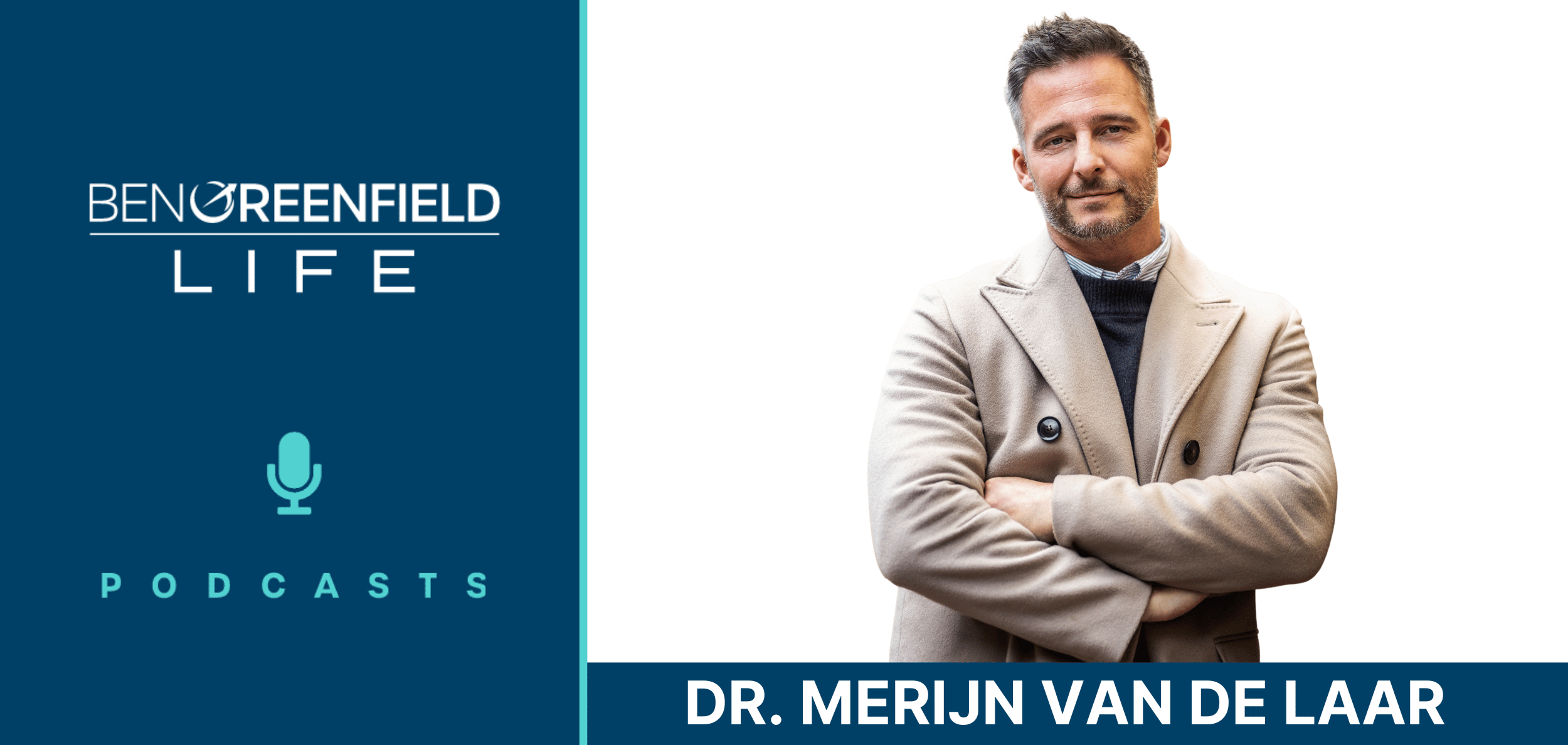
6 Hours Of Sleep Per Night Is OK??? Plus How To Sleep Like A Caveman (Wisdom From Our Ancestors For A Better Night’s Sleep!) With Dr. Merijn van de Laar
Reading time: 7 minutes
What I Discuss with Dr. Merijn van de Laar:
- Dr. Merijn’s fascinating book How to Sleep Like a Caveman, which explores our ancestors' natural sleep rhythms to help you sleep better in the modern world…01:47
- How sharing a bed can improve sleep when partners are truly connected, but sometimes, sleeping apart is the better way to show love and get real rest…06:22
- Why waking up at night isn’t always a sleep problem and sometimes is a natural, protective behavior rooted in our ancestors' need to stay alert for danger…11:59
- How waking up at night isn’t always bad, how relaxing and not forcing yourself back to sleep is key, and how different sleep patterns may have helped our ancestors stay safe…18:54
- How most people don’t actually need eight hours of sleep, how your natural sleep rhythm is hardwired but can be gently shifted, and why habits like napping or waking at night are more normal than you think…24:10
- How dreaming supports emotional processing and creativity, while sleep aids like cannabis or sleeping pills may relax you but also block the brain’s most restorative dream cycles…32:29
- How insomnia can be triggered by stress, trauma, or high sleep reactivity, how treatments like cognitive behavioral therapy (CBT), eye movement desensitization and reprocessing (EMDR), and relaxation techniques can help, and the effect of things like alarms, snoozing, and weighted blankets on sleep…42:05
- Answers on pets' effect on sleep, and why orgasming is one of the most natural ways to relax into deeper rest…52:44
- Delayed sleep phase syndrome, a condition where your body naturally wants to sleep and wake up much later than normal, and how to gradually reset your internal clock to overcome it…56:20
- A practical 3-week roadmap to better sleep, covering everything from ignoring fear-based sleep myths and tracking your real needs, to respecting your body’s rhythm, staying consistent, and making small daily changes that actually work…1:00:24
I’m always on the lookout for a good book on sleep, and I recently read one of the better titles I’ve found in the past few years:
How to Sleep Like a Caveman: Ancient Wisdom for a Better Night's Rest—Based on the Evolutionary Science of Sleep from Saber-Toothed Tigers to Modern Insomnia.
Written by today’s podcast guest, Dr. Merijn van de Laar, one of the world’s leading sleep scientists, it is a bit like Sapiens meets Why We Sleep in an evolutionary romp through the science of sleep—and how you can get better rest.
You will spend roughly a third of your life in bed, but not all of that time is spent sleeping. You might aim for eight hours each night, only to lie awake thanks to stress, glowing devices, a newborn’s cries, or that 4 p.m. coffee you thought you needed.
As Merijn shows, you're hardly the first to experience this. When Homo sapiens evolved hundreds of thousands of years ago, when saber-toothed tigers were their biggest nighttime worry, wakefulness served to protect one’s tribe at night.
Research shows these episodic sleep patterns even gave our ancestors an evolutionary advantage. Their example can guide you in improving your sleep health—from understanding how sleep patterns shift with age, to appreciating the benefits of communal sleep, and recognizing the role of environmental factors like temperature and light. While your myriad gadgets may distinguish you from early humans, understanding the ways your brain evolved to rest can chart the course toward a better night’s sleep.
Drawing from emerging science, archeological research into our ancestors’ habits, and close observation of contemporary hunter-gatherer cultures, How to Sleep Like a Caveman explains everything from why you sometimes jerk awake at night—likely a remnant of having slept in trees—to why your efforts to “optimize” your sleep schedule might just be a fool’s errand. The result is a surprising, accessible new framework for thinking about sleep—the way you were designed to.
Merijn van de Laar studied biological psychology at the University of Maastricht and obtained his Ph.D. on the subject of personality and sleep and the treatment of insomnia. He worked for years at Kempenhaeghe, Center for Sleep Medicine, and treated people with insomnia, parasomnia, and delayed sleep phase syndrome. He is now adjunct director at the University of Maastricht.
Merijn’s professional and personal mission is to create restful nights across the world. His motivation to give people a better night’s sleep arose when he experienced what it was like to have chronic insomnia in his twenties.
He did not receive the right care and, in retrospect, not the right scientifically substantiated information that could have helped him get rid of the problem much sooner.
Merijn’s slogan is “Sleep is Cheap.” By this, he means that most people with insomnia do not need expensive products, apps, or medication at all, and that these often don’t help or even worsen the problem.
If you’re curious about the science of sleep, what our evolutionary past can teach you, and actionable ways to wake up truly rested, this episode is for you.
Please Scroll Down for the Sponsors, Resources, and Transcript
Episode Sponsors:
CAROL Bike: The science is clear—CAROL Bike is your ticket to a healthier, more vibrant life. And for a limited time, you can get $100 off yours with the code BEN. Don't wait any longer, join over 25,000 riders and visit carolbike.com/ben today.
Gameday Men’s Health: Gameday Men's Health offers science-backed, physician-led men's health optimization with personalized protocols for testosterone, peptide therapy, ED treatment, and more—helping you perform at your best whether you're training hard or keeping up with life. Visit gamedaymenshealth.com/bengreenfield for a free testosterone test and consultation at a clinic near you.
Just Thrive: For a limited time, you can save 20% off a 90-day bottle of Just Thrive Probiotic and Just Calm at justthrivehealth.com/ben with promo code BEN. That’s like getting a month for FREE—take control today with Just Thrive!
Calroy: Head on over to calroy.com/ben and save over $50 when you purchase the Vascanox (a breakthrough product providing nitric oxide support for up to 24 hours with a single dose) and Arterosil (a premier supplement to support the endothelial glycocalyx—the fragile inner lining of the entire vascular system) bundle at calroy.com/ben. Plus, you'll receive a free canister of 2-in-1 Nitric Oxide Test Strips with a 3-pack bundle purchase.
Ketone-IQ: Ketone-IQ delivers science-backed performance fuel that increases power output by 19%, reduces fatigue by 10%, and naturally boosts EPO production for better oxygen delivery—trusted by elite athletes like Jon Jones and Olympic champions. Save 30% on your subscription plus get a free gift with your second shipment at Ketone.com/BENG.
Resources from this episode:
- Dr. Merijn van de Laar:
- Podcasts:
- Books:
- Articles:
- Heart Math Institute and the Equine Connection: A Scientific Approach to Healing at Henry’s Home
- Hypnic Jerk: Why You Twitch When You Sleep
- COMT Gene Mutation and Sleep: Unraveling the Genetic Link to Sleep Disorders
- The 6 Secrets of the Hadza Tribe: What We Can Learn About Health and Longevity
- Our ancestors probably didn’t get 8 hours a night, either
- Robert Owen: The Father of Socialism and the 8-Hour Workday
- Am I Getting Enough Sleep?
- Snooze patterns vary across cultures, opening eyes to evolution of sleep
- A New Look into the Sleep Patterns of Ancient Tribal Societies
- Eye Movement Desensitization and Reprocessing (EMDR) Therapy
- What is Cognitive Behavioral Therapy (CBT)?
- Studies:
- Sleep characteristics across the lifespan in 1.1 million people from the Netherlands, United Kingdom and United States: a systematic review and meta-analysis
- Stress and sleep reactivity increase risk for insomnia: highlighting the dynamic interplay between sleep-wake regulation and stress responsivity
- The sleep response to stress: how sleep reactivity can help us prevent insomnia and promote resilience to trauma
- Sleeping hours: what is the ideal number and how does age impact this?
- Natural Sleep and Its Seasonal Variations in Three Pre-industrial Societies
- Effects of Cannabinoids on Sleep and their Therapeutic Potential for Sleep Disorders
- The Overfitted Brain: Dreams Evolved to Assist Generalization by Erik Hoel
- Sleep on it: A pilot study exploring the impact of sexual activity on sleep outcomes in cohabiting couples
- Zzz’s and the Big O: Investigating the Impact of Orgasm on Sleep Quality in Women
- Delayed Sleep Phase Syndrome or Disorder (DSPD)
- Bed-Sharing in Couples Is Associated With Increased and Stabilized REM Sleep and Sleep-Stage Synchronization
- Bed Sharing Versus Sleeping Alone Associated with Sleep Health and Mental Health
- Adaptive Solutions to the Problem of Vulnerability During Sleep
- Other Resources:
- Dexcom G7
- NuCalm
- Melatonin (use code BEN10 to get a 10% discount)
- Mirtazapine
- Trazodone
- Amitriptyline
- Sleep Mask
- Gravity Blankets
- Yoga Nidra
- AYO App
- retimer
- Collagen
- Honey
- Amino Acids
- Kempenhaeghe, Center for Sleep Medicine
Ben Greenfield [00:00:00]: My name is Ben Greenfield, and on this episode of the Boundless Life podcast.
Dr. Merijn van de Laar [00:00:04]: The second thing has to do with creativity. So, the bizarreness of Dreams. And this is a very interesting research from Eric Hoel. He's a neuroscientist. He has this theory that the bizarreness of dreams actually makes our brain more flexible because.
Ben Greenfield [00:00:21]: Welcome to the Boundless Life with me, your host, Ben Greenfield.
Ben Greenfield [00:00:25]: I'm a personal trainer, exercise physiologist, and nutritionist.
Ben Greenfield [00:00:29]: And I'm passionate about helping you discover unpacking, unparalleled levels of health, fitness, longevity, and beyond.
Ben Greenfield [00:00:42]: Well, it is no secret that I am a fan of all things sleep. I've done many podcasts on sleep. Obviously, I think most people know that it's very important. And there are a lot of books that come out these days about sleep. I read a lot of them, and one of the best ones that I've read in some time is this book. I'm holding it up for those of you watching the video. It's called how to Sleep Like a Caveman. I always kind of thought maybe caveman ancestors just slept in terror from the prospect of a saber toothed tiger.
Ben Greenfield [00:01:17]: But there's a little bit more to it than that. And my guest is a guy who really knows sleep. He's actually a sleep scientist, Dr. Merijn van de Laar. Hopefully I'm not totally butchering your name there. I've practiced twice before the podcast, Merijn van de Laar, and this book is just fantastic. Merijn. How does somebody even become a sleep scientist?
Dr. Merijn van de Laar [00:01:45]: First of all, I started off as a psychologist. So I did my education in Holland to be a psychologist, health psychologist. And then I started treating people with anxiety and depression. And from that, I started to get more focus on sleep because I saw that a lot of my patients were suffering from sleep problems. So I started working at a center for sleep medicine in Holland, and that's where I did my PhD on insomnia and the treatment of insomnia. So that's how I got to be a sleep scientist.
Ben Greenfield [00:02:16]: Okay, got. Is that where you live now, in Holland?
Dr. Merijn van de Laar [00:02:19]: Yeah, Yeah, I live in the Netherlands. Yeah.
Ben Greenfield [00:02:22]: Okay. How old is this book? Because mine still says uncorrected proof, not for sale. Oh, yeah, I got the fresh batch. But is this thing out now?
Dr. Merijn van de Laar [00:02:29]: Yeah, it is out. Yeah, yeah, it went out last May, so a couple of months ago.
Ben Greenfield [00:02:35]: Okay. I just must be late to the game. The title is interesting. Obviously, Sleep Like a Caveman or How to Sleep Like a Caveman. So coming back to, like, prehistoric times, I realize this might Be a little bit of a complex question, but what exactly did the, I guess, like the bedroom or the sleeping environment look like in those ancestral times?
Dr. Merijn van de Laar [00:02:57]: Yeah, I mean, that's a good question. And we know from archaeological findings that it wasn't as comfortable as our bedrooms. Actually. They. They were sleeping on leaves and grass, and they were using plants against insects because we know from. From. From the types of plants that they used, where they slept on, that they were actually determined for insects. Yeah.
Dr. Merijn van de Laar [00:03:18]: So it was not as comfortable as our bedroom right now.
Ben Greenfield [00:03:21]: Okay, so how do we actually know. What do we look at to see how our ancestors slept? That's something I've wondered. When people say, well, they had split sleep times or they slept X number of hours per night, how do we actually know?
Dr. Merijn van de Laar [00:03:34]: Well, the thing is that if you want to really study sleep in a person, then you have to actually study a live person. So your question is quite correct. Like, how do we know? The only thing we know is that if you look at traditional tribes that still live in the same circumstances as we did, probably a couple of 10,000 to 100 thousands of years ago, then we see that they actually had a rhythm that was really much adapted to nature, to light, to temperature. And from these contemporary tribes we studied, and we see from them that we probably slept like that 10,000 to 100,000 years ago because they are not disturbed by light, by heating. They just live with natural circumstances.
Ben Greenfield [00:04:23]: Okay. There's this theory that I've come across, it might have been in your book, that we at one time slept in trees. And that might even explain that kind of like twitching phenomenon that happens right as you're falling asleep, that maybe that was to protect us from falling to an untimely death as we passed away in a tree. Is there anything to that idea?
Dr. Merijn van de Laar [00:04:44]: Yeah, well, it's an evolutionary theory. And what they say is that hypnic jerks, that's what they're called. So when you fall asleep, then your body twitches, and sometimes you get the sensation of falling. And the theory, the evolutionary theory, is that it actually is preventative or preventive for falling out of the tree. Because especially if you're tense or if you're experiencing danger, then it's extra important to lie comfortable and correct in the tree. So actually twitching is probably preventive for falling out of the tree. Yeah, that's the evolutionary theory.
Ben Greenfield [00:05:17]: Okay. Here's another saying that people say. I think there's something to this, that you shouldn't do things in bed that will cause your brain to associate your bed with work, like reading a business book or replying to emails or something like that. You know, the classic just like, you know, lay on your stomach on your laptop in bed, you know, banging out slack messages. But people often say, well, it should be for sleep or for sex. So when it comes to. Down to like the. The anthropological evidence or what our ancestors did, did they have sex in their sleeping spaces?
Dr. Merijn van de Laar [00:05:50]: Well, probably not. If we look at the traditional tribes again, then they. We see that they were actually sleeping with like 20 to 25 people around a campfire and they were not having sex. They are not having sex in their own beds. They actually go out into the jungle and have sex there where they're not confronted with other tribes members. So, and that has to do probably with jealousy or with not wanting to be exposed while doing the deed. So we probably think that our ancestors did the same.
Ben Greenfield [00:06:22]: Okay, so this is kind of related to that. And I think this is an increasingly common phenomenon, this idea of not sleeping with your partner. I've even heard it called sleep divorce. Obviously a completely different scenario than the COVID act of sneaking out to the jungle to have sex. But what do you think about this idea of sleep divorce?
Dr. Merijn van de Laar [00:06:44]: Well, I think it's always important to prioritize sleep, to really look at how can you sleep better? Because, I mean, if you sleep better, then you're more attractive, then you're more stable if you look at your mood and how you feel. So you are actually a better partner if you sleep better. And I met couples in my work in which the woman was sometimes sleeping terribly because her man was snoring or vice versa. The man couldn't sleep well because his wife was not really relaxed when she was in the bed. She was turning a lot. And then sometimes I discussed this and I said to them, well, I think it's very important to prioritize sleep but also to discuss how you're going to do this, because if you love each other, then you also have to give each other the chance to sleep well and to be a better partner. And often these partners came to a conclusion that, for example, two nights a week or three nights a week, they were sleeping separately. So I think it's very good to discuss this as well as other things in the relationship.
Ben Greenfield [00:07:48]: Yeah. And I think that part of this, the interesting thing about loving your partner enough to let them sleep in a different room, I think it's a little bit paradoxical also because I think this was in your book when people were surveyed about the level of connectedness that they felt with their partner. Those people who seem to be better connected to their partner seemed to have more synchrony of brainwaves or slept better with each other than people who felt more distant. Anybody who's had an argument with their spouse probably knows you don't sleep as well in the same bed with them. But is there something to that idea that if you're really, truly connected, you might have a better night of sleep with your partner?
Dr. Merijn van de Laar [00:08:29]: Well, I think so. But as I said, there are sometimes circumstances that can really be disruptive for your sleep that don't have to do with connectedness, like a person snoring or a woman who is very busy in the bed and tossing and turning. But in general, you can say that. And it's a very interesting research, actually, that showed that, yeah, our sleep does look alike if we are more connected. And I thought that was a very interesting finding.
Ben Greenfield [00:08:58]: Yeah, yeah, I think it was the Heart Math Institute where I first came across research that similar to how when a jockey walks into a horse stable, if they have a connection with that horse, their heart rhythms align, like the electromagnetic signals or the heart rate variability or the heart rhythm in some way aligns. And perhaps the same could be said of two people in a relaxed setting together, that maybe if they are really relaxed and the other partner isn't stressing them out, that there might be a combinatorial effect of their two different wavelengths that could potentially enhance sleep.
Dr. Merijn van de Laar [00:09:32]: Yeah, I think so. And I think we have mirror neurons that usually if a person has a certain mood or something, then we tend to take up that mood as well because we're connected to each other. And the thing is that what was so interesting about this finding is that it actually also seems to happen during sleep when you're not really conscious of how the other person is feeling or in what sleep stage a person is. So, yeah, I thought that was very exciting.
Ben Greenfield [00:09:59]: Yeah, I sleep much better with a partner, incidentally, to the extent to where when I'm traveling or when my wife is gone, I have to have a giant pillow to spoon with, because my wife and I just fall asleep, like in a pretzel shape on top of each other. And maybe this is why I really thrive on those bed cooling devices or some type of a cool mattress, because she is a furnace. I mean, she just puts out so much heat. But it's worth it to me. I still sleep better just completely almost on top of my wife.
Dr. Merijn van de Laar [00:10:32]: Oh, yeah. And how does she feel about that?
Ben Greenfield [00:10:37]: I like to tell myself that she likes it. She doesn't complain about it. So although she does tell me when I get home from travel, she always kind of like subtly mentions that, man, I, I slept so well when you were gone, so. Oh, yeah, yeah, the back of. The backhanded. The backhanded remark. Okay, so you, you claim in the book that many of our modern sleep problems might have their origin in prehistoric times. What do you mean by that?
Dr. Merijn van de Laar [00:11:06]: Well, first of all, I think that being awake, in essence, is not a problem. I think that if you look at these traditional tribes and you see that being awake for like two to two and a half hours during the night, I mean, these people sleep for 6.2 to 6.5 hours and they're awake for two and a half per night. And they don't experience this being awake as a problem. And actually being awake during the night has an evolutionary function because if you look at this tribe and you look at like a general night, there's less than one minute that everybody's sleeping at the same time. So there's always somebody awake who can sense danger.
Ben Greenfield [00:11:45]: Yeah, like the, the, the, the sentry.
Dr. Merijn van de Laar [00:11:49]: Yeah, yeah, yeah, yeah, true. And I think that what we've lost is we've lost touch a bit with that being awake during the night is normal. Because I think that you see a lot in the media, social media, that you have to sleep without any interruptions, and there's this, this, this big thing going on that you have to have perfect sleep. And I. If you look at western populations, there's a big, big research in 1.1 million people, Americans, people from the UK and the Netherlands. So these three, three groups. And what they found was that, that actually being awake for up to 20% per night is quite normal. And that's.
Dr. Merijn van de Laar [00:12:24]: Nobody talks about that.
Ben Greenfield [00:12:26]: No. Well, I would say sometimes people talk about it, but they almost make you feel guilty about it. Some of these wearable device companies or whatever, you get a slap on the wrist and a decreased sleep score. If you have increased on most of them, they call it restlessness. Right?
Dr. Merijn van de Laar [00:12:40]: Yeah. And I think that being awake in itself is not a problem. It's actually part of the night. And that's why I always say that sometimes restful nights are more important than sleep. But because if you're awake and you feel rested while awake, then that doesn't have to be a problem.
Ben Greenfield [00:12:57]: I have a few questions about this whole idea of kind of like that sentry phenomenon. The first is, do you think it varies from person to person because you hear people talk about the. I think it's the COMT dream. Some people are warriors, some people are worriers. And worriers tend to kind of like stay up late with ruminating thoughts or have a little bit more anxious sleep. And then others can just sleep through the night, you know, through the loudest of noises or alarms or dogs or whatever. So is there a pretty good amount of variability?
Dr. Merijn van de Laar [00:13:28]: Yeah, we see there's a lot of variability. We see that 50% of all people are not sensitive to developed sleep problems. So 50% are. And that means that there's like a factor that is very important. It's called sleep reactivity, which is inheritable. So if your dad or your mom has it, then there's a big chance you're getting it too. And it means that you're actually sensitive to develop sleep problems or insomnia when you're facing challenges throughout your life. So I think that's the first one that really gives a lot of variability in people.
Dr. Merijn van de Laar [00:14:05]: And then there's a second thing. I think that what you see is that some people deal with a lot of problems in their life. And if you have a lot of tension and if you have a lot of things going on, like financial problems, marital problems, then stress goes up. And you were talking about what are the things that we can relate to back in the days when you look at current sleep problems, I think that being stressed out is actually a signal for our body to be more awake during the night, because our body interprets this as there's more stress, there's more to react to, so we have to be more awake during the night. So I think that that's also variability what happens in somebody's lives.
Ben Greenfield [00:14:45]: Right. So not to kick the saber tooth tiger analogy to death, but like, if there were a tiger or a wolf or attacker, or you were in the midst of a battle with a neighboring village or something like that, it would actually serve you well to be sleeping lighter so you didn't get a spear thrust through you while you were asleep or something like that.
Dr. Merijn van de Laar [00:15:02]: Yeah, direct survival is always prioritized by our body and by our brains.
Ben Greenfield [00:15:07]: The thing that I'm also wondering about this is last night, ironically, I had a pretty crappy night of sleep starting at about 3am and I know the reason why. As you can see, I'm wearing a blood glucose monitor, but I switched to a different brand last week called a Dexcom G7. And I cannot for the life of me figure out how to turn the alarm off when the blood glucose goes low. Now, this thing has worked fine for the past week. Then I did a sauna session yesterday and it was a pretty hot sauna session and apparently it threw the blood glucose monitor for a loop because it told me, and I know this wasn't the case because I was eating well, it told me my blood glucose was at like 50 and it got so low that at 3am this loud blaring alarm goes off from my phone. I sit bolt upright thinking I've got a house invader or something and it's my blood glucose. I didn't fall asleep until 4:30am and then it was pretty light from there. But the reason I'm telling you this is I often wonder if you do wake up at night, whether it's an alarm or dog barking or baby needing a feeding or something like that.
Ben Greenfield [00:16:21]: Is there any evidence about how long it should take someone to fall back asleep? Or is there any even beyond that tips that you have to fall back asleep faster when you've had something jarring that awakes you in the middle of the night like that?
Dr. Merijn van de Laar [00:16:36]: Yeah. What you're describing is actually an event in which your alertness goes up immediately because you have this alarm going off and you're in an immediate state of arousal, which is far from sleep. So that's what happens. So I think one of the first things that you need to do to fall asleep better is to de arouse. And I think that the amount of time that it takes you to fall back asleep again, I think a lot of people are worried about that. I think we shouldn't be worried about that that much. We should be worried more about when you're in the bed and you are relaxed. So first try to relax.
Dr. Merijn van de Laar [00:17:12]: And how can you relax? I think a very important one is to if your arousal is too much up, you have to go out of the bed, do something that relaxes you, that gives you good feeling, and then go back in the bed again when you're relaxed. Sometimes we say you have to go back in the bed when you are sleepy. But I think if you are relaxed and you're lying in the bed relaxed and your blood pressure is going down, your heart rate's going down, then there's no issue with that. That's okay.
Ben Greenfield [00:17:42]: So this would be like getting up and taking a Valium. Like what are we talking about when it comes to doing something that relaxes you? I'm joking, by the way. Yeah, I'm joking too. Don't take advantage of it.
Dr. Merijn van de Laar [00:17:53]: It's not good for your sleep quality. No, I think it would be A good thing to watch a documentary, a book, not to be in too bright light, because that can disrupt your biological clock, but do something that really relaxes you. And yeah, sometimes people read or they do a little puzzle or that kind of stuff, but yeah, so I think that's usually the best advice to get.
Ben Greenfield [00:18:16]: Yeah, I find all those type of things too stimulating. I mean, in the past, usually I've used some kind of relaxing sounds, but not gotten out of bed. Like, I have one app that I really like. Maybe you've heard of it before. It's called nucalm, and it plays these super relaxing beats. That one is one that can help me sleep on an airplane, hotel room, whatever. Didn't work too well last night. That blood glucose thing was just annoying me.
Dr. Merijn van de Laar [00:18:40]: Yeah, I think the thing is that things work at a different arousal level. I think last night you were too aroused, so that's why the sounds don't work. But if you're just waking up and you're a little bit thinking or whatever, then this might work. But sometimes if you're too aroused, you have to go out of bed.
Ben Greenfield [00:18:56]: Okay, got it. So there was this guy, Michael Breus, who wrote a book called, gosh, what was it? It was like The Power of Sleep, something like that. But in the book he has these four chronotypes. The lion, the bear, the dolphin and the wolf, I think are the four that he has. And he's talking about what you'll hear some people talk about now. Also the idea that we have chronotypes, the different people sleep better at different times. Based on this back to the ancestral piece. Is there something to that idea from an ancestral standpoint?
Dr. Merijn van de Laar [00:19:27]: Yeah, definitely. I think first of all, if we look at the theory of Breus, it's a very interesting theory, but there's not much scientific evidence to back that up. So I think we have different chronotypes, but if we look at research, then it's quite different. You have like morning types and evening types and everything in between. Most people are in between. So if you're a morning type and you generally fall asleep around like 10 or earlier, if you're an evening type, it's more like 11:30pm to the middle of the night. And then you have these more night types falling asleep after 12, maybe later, but most people fall in between. And if you look at our ancestors, probably these different chronotypes have helped us to be on guard more during the night.
Dr. Merijn van de Laar [00:20:10]: Because if you have a lot of people falling asleep very late and also a lot of people getting up in the morning very early, then you have a smaller amount of time in which everybody's sleeping at the same time. So different chronotypes have probably helped us to survive.
Ben Greenfield [00:20:24]: Okay, so let's say taking that one step further, that now we don't have the same survival needs, but maybe we have this genetic chronotype still built into us. Like, let's say we sleep best from 2am to 10am but from a social standpoint, if you gotta be at work at 8am, that doesn't help you out too much. Is there a way to adjust your chronotype or kind of like sleep in a way that might not parallel your chronotype but still be able to tap decent sleep anyways?
Dr. Merijn van de Laar [00:20:53]: Yeah, I think first of all, it's very important to really know what your chronotype is. So it's. I mean, you cannot change your chronotype, but you can do like another chronotype. It's like, like dyeing your hair. If you're blonde, you can dye your hair to being a brunette, but you're still a blonde underneath. And that's the same thing with chronotypes. So if you're a morning type who wants to be more of an evening type, then you can work with light in the evening because light really adjusts our biological clock. So light later in the evening can push our clock more backwards, which gives us a later sign of wanting to fall asleep.
Dr. Merijn van de Laar [00:21:31]: The opposite, if you are an evening type and you want to be more of a morning type, then it's very important to work with light in the morning. So light in the morning, but also keeping it dark in the evening can help your biological clock to adjust a little bit. And usually our biological clock can adjust for like 1 1/2 to 2 hours without too much work. If it's more, then sometimes you need more. Like, and this is always doctor's prescription, but like melatonin or guidance from a specialized sleep expert.
Ben Greenfield [00:22:01]: Right. This would be similar to the jet lag or the advice for getting used to a new time zone. Like if I travel from the East Coast back to my home on the West Coast and it's 7am on the West Coast, but it's 10am on the East Coast. I could use a whole bunch of bright light in the morning to get myself back onto my sleep schedule or something like that.
Dr. Merijn van de Laar [00:22:22]: Definitely. Yeah.
Ben Greenfield [00:22:24]: Okay. So the amount of time that even modern hunter gatherers actually sleep was a little surprising to me. It was like six, six and a half hours, something like that. Did that surprise you actually didn't.
Dr. Merijn van de Laar [00:22:37]: And that's because I know if you look at the sleep in Western populations, it's actually quite the same. So if you look at research in Western sleep population, then they usually ask the people to give an amount of hours that they were sleeping. And generally if we look at this UK, US, the Netherlands study, then you see that people on average report that they sleep for 7 hours. Now these tribes slept between 6.2 and 6.5 hours, but it was measured differently. So they used an actigraph, which is a medical device which works in a different way. And usually it might be like 20 to 30 minutes difference between what an actograph scores and what a person subjectively thinks that he or she slept. So basically it's the same meaning that.
Ben Greenfield [00:23:24]: If you use an actograph to measure what they did with like, I think it was the Hadza tribe, they're showing that they're sleeping like six and a half hours. And if we were to actually use that in, let's say somebody living in LA who's reporting that they're sleeping eight hours, they're actually sleeping closer to what one of these hunter gatherers are sleeping.
Dr. Merijn van de Laar [00:23:46]: Yeah, yeah. Usually you can subtract like half an hour off and on average we see that people in Western society sleep around seven. That's the average. So not eight. There's only 10 to 25% of people who sleep eight or more.
Ben Greenfield [00:24:00]: Okay, well I'm sure everybody's wondering where the hell this whole like 8 hours of sleep a night is necessary idea came from then.
Dr. Merijn van de Laar [00:24:08]: Well, it has different sources. The first one was Robert Owen. Robert Owen was a social reformer from Wales and he lived during the Industrial Revolution. And what he said was that everybody needed to work for eight hours to have leisure time for eight hours and to sleep for eight hours because he thought that people were working too long in the factories.
Ben Greenfield [00:24:29]: This does not sound like highly scientific though. This was not a sleep lab study.
Dr. Merijn van de Laar [00:24:34]: Yeah, so he had a lot of influence and that's what we see in the current days, that still people think 888, that's the. And then also Matthew Walker, who made a book, Why We Sleep, which was actually, I mean it was a good book. But if you look at his advice to sleep for eight hours, then you see that all the research after the book that Matthew wrote shows that actually close being closer to seven. And the range of six to eight is actually more associated with health factors and is more how people sleep in reality. And that's what he says what we see is that there's still an advice of 2015 in which the National Sleep foundation says you have to sleep in between seven to nine hours. I think that's a little bit on the long side. If you look at population studies from 2015 until now, then you see that around 7 for most people is fine. And there's a lot of variability, variability here.
Dr. Merijn van de Laar [00:25:31]: So between 6 and 8 is, is quite average. But there are also people who need less than six and also people more than eight. But it's a very small group.
Ben Greenfield [00:25:39]: Yeah. Because you hear about some professional athletes who are doing like 10 a night.
Dr. Merijn van de Laar [00:25:43]: Yeah. And what we see is that if you look at professional athletes who say that they need 10, I mean it might be, it might be that there are very few people who need 10 hours. But what we see is that you put people on like a training, an exercise training and you follow them for a year, then they actually sleep more in the amount of 10 minutes more and not hours more if they are exercising for a longer time.
Ben Greenfield [00:26:08]: What do you think about napping? Because I tend to go about six and a half to seven hours a night because I like to get up early, not 3am early like last night, but I like to get up somewhere early. But I usually take like an afternoon siesta, like 20, 45 minute siesta.
Dr. Merijn van de Laar [00:26:22]: I think that napping is good, but it depends on what kind of sleeper you are. So if you're a good sleeper, then we know that napping can really give you a better way of solving problems. It can make you more alert, it can improve your mood. But if you're a bad sleeper, then it can actually decrease your sleep drive, which can give you more sleep problems during the night.
Ben Greenfield [00:26:46]: Oh, you mean like if you have insomnia, this whole idea of like keep yourself awake no matter what, or if you have jet lag, just like stay awake at all cost, that when you get into bed you're just so exhausted you have no option but to sleep.
Dr. Merijn van de Laar [00:26:58]: That's it. Yeah.
Ben Greenfield [00:26:59]: Okay. So is the whole napping idea then something that. How do I want to say this? When you go to a lot of cultures, like I was in Spain, it just seems built into society to nap. And I've wondered, does that come from some ancestral need? Is that more social? Just the idea of a siesta shutting down businesses from 2 to 4pm like why is it that you see that built into a lot of cultures?
Dr. Merijn van de Laar [00:27:27]: Yeah, I think it's cultural variation first of all. And it sometimes has to do with temperature. Or we see that some tribes, like a group in Madagascar, actually sleeps in two parts of the night. So they don't really nap during the day, but they go to bed very early, then they're awake in the middle of the night, and then they do their second part of sleep. If you look at the Hadza tribe that we were talking about before, they see that they nap once in two days, in which they do a nap, on average, it gives them 17 minutes more sleep per day. So it really depends on the culture that you're in. Sometimes it has to do with religion because some cultures you have to get up very early to do the morning prayer. So what we see is that sleep is actually quite flexible and that there's no one good way of sleeping.
Dr. Merijn van de Laar [00:28:16]: So if I talk about Sleep Like a Caveman, I'm not saying that we all should Sleep Like a Caveman, but what can we learn from other cultures, what can we learn from probably our ancestors to know more about the biology of sleep and how we can influence it?
Ben Greenfield [00:28:29]: Yeah. And granted, when I was in that northern region of Spain, it was also super easy, a dinner reservation. My normal time was 7pm because people didn't even go out to dinner till like 9 or 9:30. So then maybe that's part of it too, just like super late nights. So the part about dreaming I thought was interesting, especially why we dream. I think this is important for two reasons. One, the importance of dreaming as a whole. And two, and I'd love to hear your thoughts on this, I know there's certain things people use for sleep, like cannabis, for example, that suppress.
Ben Greenfield [00:29:03]: Has been shown to suppress dreaming cycles. So curious about the importance of dreaming and also what you think about some of these things that seem to help people sleep but also suppress dreaming cycles.
Dr. Merijn van de Laar [00:29:13]: Yeah, well, dreaming actually has. My new book is on dreaming. I've wrote a new book on dreaming about that. Like the history of dreaming and what. What dreaming is actually for in the neuroscientific approach.
Ben Greenfield [00:29:24]: What's the name of the book?
Dr. Merijn van de Laar [00:29:25]: It's not out yet, so I'm still writing it. So it's going to be published in Finnish and in Spanish, but I'm still waiting for probably the. The American or English version.
Ben Greenfield [00:29:34]: So it would be Dream like a Caveman.
Dr. Merijn van de Laar [00:29:36]: Yeah, Dream Like a Caveman. That would be a good title. Yeah. No, dream. Dreaming is actually important for a couple of things. The first thing is it probably has a very important role in your emotional functioning and in. If you. If you conquer things during the day, if you counter things during the day, then our dreaming really helps us to process these things.
Dr. Merijn van de Laar [00:29:59]: And we know that from neuroscientific research, because the amygdala, which is a very important structure in the brain that really has a very important function in emotions, is very active during dreaming, is very active during REM sleep. Now, we dream during every stage in the night. So some people think we only dream during REM sleep, but that's not true. But the dreams that we can remember, that we mostly can remember, that are more story like, they are usually the REM sleep dreams. And I'm talking about these dreams. If I'm talking about emotional things and emotional processing. Now, that's the first thing. The second thing has to do with creativity.
Dr. Merijn van de Laar [00:30:35]: So the bizarreness of dreams. And this is a very interesting research from Eric Hoel. He's a neuroscientist, and he has this theory that the bizarreness of dreams actually makes our brain more flexible. Because during our dream, we have a virtual reality environment. And in this virtual reality environment, we act and we do like it's the real world. So if we're confronted with bizarre things and things that are really off our usual schedule, then it has to. We have to be creative in solving these problems and things that we counter during our dreams. And what he said, and this is very interesting in his article, is that when you make artificial intelligence systems dream, they actually get more intelligent.
Dr. Merijn van de Laar [00:31:21]: They are more adaptive to changing environments and changing circumstances, and our brain is like a supercomputer in which the same thing happens.
Ben Greenfield [00:31:30]: That is fascinating. How do you make an artificially intelligent system dream?
Dr. Merijn van de Laar [00:31:35]: Yeah, well, I think by giving it bizarre data sometimes, or data that's a little bit off, that is not really usual. Yeah.
Ben Greenfield [00:31:43]: Okay. All right. So that makes me wonder. This, like THC or cannabis is something a lot of creatives use to enhance creativity. Is it possible that they're just creating enough creativity during waking hours that they don't need it during sleeping hours?
Dr. Merijn van de Laar [00:31:58]: Well, I think that if you look at THC or cannabis, then you see that what you said before, it suppresses REM sleep. And if you stop. If you stop using it, then you get REM rebound. So what we usually see is that these people start dreaming a lot if they stop with it. I don't think that. I mean, I think that using cannabis during the day can make you more creative, but I think that the creative process during dreaming is suppressed. It should be. Because your REM sleep is suppressed.
Ben Greenfield [00:32:25]: It also increases daytime sleepiness. Yeah, and that was based on I think something Matthew Walker recently reported on that the association between cannabis use for sleep and increased kind of grogginess during the day, even if you're not high anymore during the day. I don't know the half life of THC in the bloodstream, but I think overall for me it fits into the same category as a sleep drug, like back to Valium or Diazepam. When I first interviewed the Navy SEAL doctor guy. Why am I blanking on his name? Do you know who I'm talking about? Kirk Parsley. When I interviewed Kirk Parsley, he said he would describe it to the SEALs who were using these type of things as the process of taking a sledgehammer to the head and knocking you out, but really not achieving normal sleep cycles.
Dr. Merijn van de Laar [00:33:13]: No, no, no. I mean, if you look at benzodiazepines like Diazepam or Temazepam, I don't know how you call it in the States, but I mean, these drugs, they really suppress your REM sleep and they suppress your deep sleep. So what happens is your natural recovery or your physical recovery, but also your mental recovery decreases. So you think that you're sleeping well. But what these drugs actually do is the thing about insomnia, if you are suffering from insomnia, I've suffered from it for three years, so that was before I started doing my PhD. So I know what I'm talking about. It's really horrible. If you're suffering from insomnia, then you're awake during the night, you can't sleep, you're really tense.
Dr. Merijn van de Laar [00:33:53]: And what these drugs do is that the thing is they make you less tense. So I was talking about being awake in itself is not a problem, but it is a problem if you're very tense. And what these drugs do is they really decrease the tension, but they also decrease your recovery during the deep sleep and the REM sleep, which is problematic.
Ben Greenfield [00:34:10]: Yeah.
Ben Greenfield [00:34:11]: For everything from, like, daytime function to recovery from workouts to, like, the dreaming and creative cycles that you talked about.
Dr. Merijn van de Laar [00:34:16]: Definitely.
Ben Greenfield [00:34:17]: Yeah. Yeah. The. The insomnia piece back to that you mentioned sleep reactivity, the propensity for certain people to have a higher amount of wakefulness in response to some kind of a stressful incident that might occur before or during bed. I think in the book you describe how the people who normally respond to the type of insomnia therapy that you would use, but who have high sleep reactivity don't do as well with what you'd normally do with someone for insomnia. So what do you do for people like that?
Dr. Merijn van de Laar [00:34:48]: Well, the first thing that is very important, if you have a person with high sleep reactivity, I was talking about genetic predisposition is one thing. But also people who have experienced traumas in their early life, like in their childhood, they can also develop high sleep reactivity because they did not develop a sense of safety. And this reflects in the night. So what these people do is they are actually more awake during the night, more trying to control whether their environment is safe. So I think the first thing that you need to do when a person is like this is developing insomnia is be quick. So if you treat these people very early in the development of insomnia, then the treatment results are better. So if somebody's traumatized, knows that they're traumatized, and they're developing sleep problems, it's very important that they seek help very early because then we see that the treatment results can be, can be better. And the second thing that comes to mind is that I did cognitive behavioral therapy in I think in total like 7 to 8,000 people.
Dr. Merijn van de Laar [00:35:55]: And I think that 85% of the people reacted positively to the treatment and 50% didn't. And then it really depends on what kind of person you have that suffers from insomnia. So sometimes you have these people who are not really traumatized, don't really know what's going on. And sometimes then medication can help, but I always do that in, in common in, in consultation with, with a physician, but usually not benzodiazepine. So you have different types of meditation medication that might work or that might work sometimes. And another group, sometimes I advise them to do more trauma related therapy like EMDR and that kind of stuff. And sometimes that works very well. Or more therapy related to being more relaxed in your body.
Dr. Merijn van de Laar [00:36:41]: So like more body related treatments, which is not the first line treatment. So that's why I usually do the golden standard cbt. But if somebody's not reacting to that, you have to do something and then you go to the more alternative treatments.
Ben Greenfield [00:36:57]: Got it. And for those of you losing track of the alphabet soup here, EMDR is the eye movement desensitization.
Dr. Merijn van de Laar [00:37:04]: Reprocessing.
Ben Greenfield [00:37:05]: Reprocessing.
Dr. Merijn van de Laar [00:37:06]: Yeah, that's.
Ben Greenfield [00:37:07]: And then CBT is cognitive behavioral therapy, right?
Dr. Merijn van de Laar [00:37:10]: Yes, that's it.
Ben Greenfield [00:37:11]: Okay. Which from what I understand is one of the gold standard treatments for insomnia, even though it's not quite popping a pill and takes quite a bit of training. You did mention, speaking of the pill popping, that sometimes you'll use medications, not a diazepam is There a medication that you find is less harmful for sleep cycles?
Dr. Merijn van de Laar [00:37:32]: Well, sometimes I discussed with a physician who was also treating because I was working in a multidisciplinary center. Sometimes the antidepressants in the Netherlands we call them mirtazapine. I don't know what it's called in.
Ben Greenfield [00:37:46]: Would this be like, like trazodone?
Dr. Merijn van de Laar [00:37:49]: I'm not sure. I'm not sure. And amitriptyline, which is also a medication that's sometimes used, but it's off label. And here again, it's usually the second line treatment that was prescribed in the sleep center.
Ben Greenfield [00:38:06]: Yeah, yeah. I heard Tim Ferris talking quite a bit about Trazodone for a while.
Dr. Merijn van de Laar [00:38:10]: Okay.
Ben Greenfield [00:38:11]: I tried it once. I've never used an antidepressant and I think it falls into that category. Absolutely hated the way I felt the next day. I didn't feel good with it at all. But it might be a different category than what you're describing. Not 100% sure. But by the way, for people who want to pipe in in the comments section, they're going to [email protected]/ Caveman Sleep. I'll also link to Merijn's book there.
Ben Greenfield [00:38:34]: BenGreenfieldLife.com/ CavemanSleep so you mentioned safety. I sometimes hear that the idea of pressure against the eyes or pressure against the body via something like say an eye mask or even a weighted eye mask or a weighted blanket might induce a feeling of safety that can help with sleep. Is that just hearsay or is there any research on things like eye masks and gravity blankets?
Dr. Merijn van de Laar [00:39:01]: Yeah, we know there's some research on weighted blankets. And if you look at all the research together and you look at the positive effects, then we see that weighted blankets can actually be used in certain populations, like people suffering from anxiety or depression. We see that weighted blankets in this population might be useful in people just suffering from insomnia, only suffering from insomnia without psychiatric comorbidity. We don't have enough evidence that weighted blankets might work. So I think it really depends on what type of person you are. Also, children with neurodevelopmental disorders, they might benefit from using weighted blankets.
Ben Greenfield [00:39:42]: Yeah. Of course, the only downside is they're very hot. So back to the.
Dr. Merijn van de Laar [00:39:45]: Yeah, they are.
Ben Greenfield [00:39:46]: Everybody knows you. Everybody knows most people sleep better. Cool. So you got to get around that talk about alarms a little bit. I don't like alarms, especially that glucose alarm thing, and tend to try to just get to the point where I'm waking at the Same time each morning, which usually happens if I use an alarm for a few days or use light for a few days, like we were talking about earlier. I don't need an alarm. But would there be any good reason for someone not to use an alarm?
Dr. Merijn van de Laar [00:40:13]: I mean, if it's possible for you to follow your own rhythm and if you always are awake before you have to go to work or your other obligations, then it's not. I mean, it's not obligatory to use an alarm. But I think for most people, what we usually see is that most people have to get up in the morning very early, especially if you look at their chronotype. And then it's sometimes very important to use an alarm because it can really give you the feeling that you have to wake up because sometimes it doesn't come internally because you have a slightly different biological clock.
Ben Greenfield [00:40:51]: Yeah, I get that, but what about the idea of. I know sunrise alarm clocks claim to help with this, as do the new cooling systems for a mattress that'll gradually warm you because a warming sensation can help to wake you up gradually. They claim that that process of waking up gradually to birdsong or gradual sunlight from an alarm clock or warming can rip you out of a sleep cycle less intensively and reduce waking grogginess. Is there something to that idea?
Dr. Merijn van de Laar [00:41:20]: Yeah, there's some evidence that it might help a little bit. So if you look at these alarms that use lights, they might support a little bit if you suffer from garginess in the morning. If you look at the other system, the warming system, I'm not sure, I'm not sure. I haven't read research on that that it might really help. I think they're still in a developmental phase and still researching it. Like how does it work and does it really help people to wake up more alert?
Ben Greenfield [00:41:49]: I personally suspect, again, I don't know about any research on this, that in the same way that cooling the body seems to improve sleep, that there's something to like warming food, exercise and light, for example, that kind of jumpstart sleep drive and therefore increase wakefulness a little bit in the morning.
Dr. Merijn van de Laar [00:42:09]: Yeah, it could be. I mean, if you look at the theory, then you're absolutely right. I think it might really be something. So, yeah, I'm looking forward to research on this part because I think it might really help people get more wakeful in the morning.
Ben Greenfield [00:42:25]: Yeah, maybe I'm just trying to get my wife to put a hot tub in the bedroom. So what about snoozing? What about if the alarm does go off? And you do hit the snooze button. Any research on whether that is good, bad or bad anything?
Dr. Merijn van de Laar [00:42:42]: Yeah, the research on that is very contradictive. And what the theory is is that if you use a snooze alarm in the morning and you then your quality sleep in the last part of the night is actually really bad because you, you wake up and you have this light sleep and then you wake up again after seven minutes and you have this light sleep again. And, and if you look at the theory, then it would be better to really have your sleep finish until the alarm clock goes, because in this way you're just waking yourself up and going back to sleep again. And we have different processes that regulate sleep. So we have the biological clocks. You have the sleep pressure, which is the sleepiness that builds up during the day. But they also think that there's a third process that really helps us to be asleep during the night. If you wake up, that really pulls you down again, really consolidates sleep during the night.
Dr. Merijn van de Laar [00:43:35]: It helps you consolidate sleep. And this process, actually they think that this process gets stronger if in the morning use your snooze alarm because then you're waking up yourself and then after seven minutes again, so your body tends to push back again more, which can make you more sleepy in the morning.
Ben Greenfield [00:43:53]: Oh, I see.
Dr. Merijn van de Laar [00:43:54]: Yeah.
Ben Greenfield [00:43:55]: So it would therefore potentially increase grogginess.
Dr. Merijn van de Laar [00:43:59]: Yeah, that's the idea.
Ben Greenfield [00:44:01]: Yeah, yeah, yeah. For me it kind of depends because I'll occasionally wake up and do one of those nucalm sessions for just like 20 minutes. And I feel like maybe it's something different about those sounds, but that one seems to almost be a form of a snooze that does make me feel like I've slept a little bit more. The other one I've used, I think I heard about this from Dr. Andrew Huberman and tried it and it kind of stuck with me. The idea of doing a brief Yoga Nidra session, like a body scan for 20 or 30 minutes that also kind of seems to like buy me a little bit of extra what seems like quality rest.
Dr. Merijn van de Laar [00:44:36]: Yeah, so that's before you get out of the bed. Right.
Ben Greenfield [00:44:39]: This would be like, let's say I want to get up at 5am but for some reason I wake up at 4:30. I'm like, I'd like to stay in bed a little longer, probably not going to sleep. So I'm going to run like a 30 minute NSDR Yoga Nidra session.
Dr. Merijn van de Laar [00:44:51]: That really fits the theory that being awake during night is not problematic as Long as it's. It's restful. So I think this is a good example.
Ben Greenfield [00:44:58]: Right. Okay. We talked about sleep divorce, sleeping in a different bed than your partner. What about sleeping with the pet or not sleeping with the pet? Any research on that?
Dr. Merijn van de Laar [00:45:09]: Yeah, there is research on that. And I have to disappoint people with cats because sleeping with a cat in your bedroom is not a good idea because cats are night animals, so they're nocturnal animals and they can really disrupt your sleep. If we talk about dogs now, I happen to have a dog myself. I have a dachshund, so I'm a little bit prejudiced. But if you have a dog, then it's fine to have the dog sleeping next to the bed in a bench. But in the bed is usually not a good idea because the dog also sometimes has a different rhythm, which can really interrupt your sleep. But there's no evidence that if the dog is in the bedroom in like a little bench next to the bed, that somebody would sleep worse. And the dog is still sleeping well as well.
Dr. Merijn van de Laar [00:45:53]: So that's a good thing.
Ben Greenfield [00:45:55]: Okay. You do say in the books. I underline this part. Older people might have more benefit and referring to the sleeping with a pet because it might help alleviate feelings of loneliness and have more impact on physical activity in the case of dog ownership.
Dr. Merijn van de Laar [00:46:09]: Yeah. Yeah, that's right. Yeah, that's it. I think that what we see in older people is that sometimes, especially if. If they had a partner and the partner is deceased and they have a pet, they go out more, they exercise more, which is good for your sleep. It really enhances sleep quality. But also I think a sense of loneliness. Loneliness is a silent killer.
Dr. Merijn van de Laar [00:46:33]: And I think that having a pet can really decrease feelings of loneliness, which is also very good for your sleep because people who are lonely actually sleep worse.
Ben Greenfield [00:46:41]: Okay. Yeah, that makes sense. Okay. So if you are lonely, isolated, older, the benefits of sleeping with a dog might outweigh the Definitely cons. Okay.
Dr. Merijn van de Laar [00:46:50]: Yeah.
Ben Greenfield [00:46:51]: There is a relatively well known podcaster, probably one of the most well known. His name rhymes with Ro Jogan and he has been known on his podcast for saying that if he wakes up at night, he'll masturbate to get back to sleep.
Dr. Merijn van de Laar [00:47:08]: Yeah.
Ben Greenfield [00:47:09]: What do you think about that? Any research on masturbation and sleep?
Dr. Merijn van de Laar [00:47:12]: Yeah. Well, if you look at orgasms and sleep, then there's a lot of research on that. And, and what we see is that having an orgasm is actually sleep promoting because all these hormones are released, all these substances are released that are really sleep promoting.
Ben Greenfield [00:47:30]: But real quick, does the orgasm research differentiate between orgasming with a partner, which. Back to the connectivity piece, the oxytocin piece, the life satisfaction piece, versus orgasming by yourself.
Dr. Merijn van de Laar [00:47:44]: Yeah, and actually the difference is not that much. Especially if you look at sexual activity. There is a difference. Sexual activity with an orgasm is actually mostly promoting. And if you look at the difference between masturbating and then having an orgasm or having sex with a partner and then having an orgasm, the difference is not that big.
Ben Greenfield [00:48:04]: Although I suppose, like, masturbation with a partner in bed might backfire. My wife would tell me to shut up and go to sleep if I was doing that. Know for a fact. All right, so. So that's interesting. So it may actually help.
Dr. Merijn van de Laar [00:48:16]: Yeah, it may help. Yeah, definitely. Yeah. And what we see is that it usually helps more in men if you look at sexual activ. And that probably has to do with the orgasm gap, that there are more men having an orgasm after sex than women in general. If you look at heterosexual couples.
Ben Greenfield [00:48:31]: Oh yeah, yeah, that makes sense. That makes perfect sense. Okay, so there's another term in the book, back to the alphabet soup. We've tackled NSDR, EMDR, BGT, DSPS. Dsps Sounds. Sounds like the mailman. But what's DSPS?
Dr. Merijn van de Laar [00:48:52]: That's Delayed Sleep Phase Syndrome or Delayed Sleep Phase Disorder. And this has to do with the chronotypes that we were talking about before. So if you have a very late chronotype in which you fall asleep very late and you wake up very late, then you might be suffering from delayed sleep phase disorder or syndrome. And this can be very, very hampering for your. For your daytime functioning. Because if you have a morning shift and you have to get out of the bed at 7 and you fall asleep at 3 or 3:30, and every night you fall asleep at 3, 3:30. So nothing can help you to fall asleep earlier. Then you're having very little sleep.
Dr. Merijn van de Laar [00:49:30]: And this really has negative consequences on your daytime functioning. So we see that these people, they tend to become sleepy during the day, they have concentration problems, fatigue. They often have difficulty coming out of the bed in the morning, which makes that a lot of time they're late at work or at school. So yeah, it's a very problematic thing.
Ben Greenfield [00:49:51]: So you have like some kind of a system. It's like a light system. We talked briefly about how you could use light for the circadian rhythm issues. But how would you describe to someone, like systematically, let's say they do have the Delayed Sleep Phase Syndrome, how they'd use light to tackle that.
Dr. Merijn van de Laar [00:50:08]: I think what happens a lot in general is that if people have a late chronotype, then they usually get the advice that they should get up in the morning very early, then use a lot of light, and then the problem goes away. And we know from, from, as a matter of fact, that it doesn't work that way. So especially if you have a. A big delay, like if you have to go asleep, fall asleep around 11, and you fall asleep around three, that's a delay of four hours. And you cannot fix that with just giving lights at 7 o' clock in the morning. So what you have to do is you have to start with your natural rhythm, which is probably three o' clock at night, falling asleep, then 11, 11, 30, going out of the bed. And then there's two ways of tackling this problem. The first one is to push the clock back.
Dr. Merijn van de Laar [00:51:00]: So what you do is every two days, you start with light in the morning, and then you get up in the morning half an hour earlier, half an hour earlier, half an hour earlier, until you're in the right rhythm. But especially in large delays, this takes a lot of time and the effectiveness is not always great. Now, there's another system that I've done a lot in, especially adolescents, because adolescents suffer a lot from dsps, and that's moving forward. So I say to the adolescent, you go to bed at 3 o' clock at night on the first day, the second day, 6 o' clock in the morning, then 9 o' clock in the morning. So you should make a shift of three hours until you're in the right rhythm and you use lights when they have to get up at that time.
Ben Greenfield [00:51:45]: So that would mean, like, at 6am you'd use a whole bunch of light.
Dr. Merijn van de Laar [00:51:48]: Yeah, yeah, yeah, yeah, yeah. So at the end of the sleep, you use a whole bunch of light, and then you shift forwards in periods of three hours. And then after seven to nine days, you usually achieve the rhythm that they want.
Ben Greenfield [00:52:03]: And I know from previous podcasts I've done with experts in the field of photobiomodulation, that sunlight due to the full spectrum is best. But they also make these big bright lights for things like seasonal affective disorder. There's even glasses now, like the iOS AYO, or the Retimers that you can kind of like wear while you're walking around. And those work if you can't get out in the sunlight.
Dr. Merijn van de Laar [00:52:26]: Yeah, yeah, that's definitely true. And the light lamps that you're talking about, the bright lights that they emit at 10,000 lux. And they are just as good as being outside. So you can use them if it's dark.
Ben Greenfield [00:52:39]: Okay, so lightning round now, Dr. van de Laar, how to get a better night's sleep in three weeks. That's a section in the book. And I'm curious if you can give people kind of like your audio overview.
Dr. Merijn van de Laar [00:52:54]: The audio overview.
Ben Greenfield [00:52:55]: How to get a better night's sleep in three weeks.
Dr. Merijn van de Laar [00:52:59]: I think. Well, first of all, and that's what I describe as the first factor, don't believe everything you read about sleep, because all you see about sleep, because I think if you look at the newspapers and if you look at the social media, then there's a lot of rubbish going on. There's a lot of people saying things that are not backed up by science and it really sucks. There's a lot of commercial things going on as well, because, I mean, people want to sell sleep trackers, they want to sell these supplements. They are giving you the idea that sleeping less than eight hours is actually killing you. And I think there's a lot of things going on that really frighten a lot of people. I think the first thing is don't believe everything you see or read about sleep. So that's the first one.
Dr. Merijn van de Laar [00:53:39]: I think the second one is, and we were talking about that before, is let go of the eight hour rule, look at your personal sleep need, and you can discover your personal sleep need by looking at the second week of your holidays. See at what time you're falling asleep and at what time you're waking up without any effort. And then you see what kind of chronotype you are and how much sleep you need. So I think that's the second one.
Ben Greenfield [00:54:03]: And by the way, just to remind people, you say in the book it's common to sleep between 5 hours, 20 minutes and just over 7 hours as measured by actigraphy. So that means for people who are getting a little under six hours to up to seven and a half hours, they don't have to guilt trip themselves.
Dr. Merijn van de Laar [00:54:18]: No, definitely not. It's very important to look at your sleep need and for a lot of people that's much less than eight hours. So don't worry too much about that. Just look at how you feel during the day and discover your personal sleep need by looking at the second week of your holidays. Okay, got it, yeah. So the third one is to use a sleep diary, not a tracker, because trackers are completely unreliable. So what we see is that if you look at commercial trackers, then they're not very good at estimating in what sleep phase you are. And they're actually quite terrible.
Dr. Merijn van de Laar [00:54:47]: And we also know that a lot of people suffer from a lot of anxiety when they get the sleep score of 72. Well, you have to start the day and they're like, oh my God, you.
Ben Greenfield [00:54:55]: Know, I slept so great. Oh wait, according to my wearable 68. Really shitty. I'm screwed. Yeah, yeah, yeah, yeah. Call into work. Sick.
Dr. Merijn van de Laar [00:55:05]: Yeah, I'm sick. Sorry, I'm not coming here. So the next one was discover your personal sleep needs. We were talking about that before. Also look at your attitude towards lying awake at night. Don't be too frightened to lie awake if you're awake. And if you just relaxed, then it doesn't have to be a problem. And there's a lot of people with you who lie awake during the night and it doesn't have to be a problem.
Dr. Merijn van de Laar [00:55:26]: There's no research saying that lying awake in itself is causing problems. So that's a very important one.
Ben Greenfield [00:55:33]: Unless it's because of like your post dinner espresso, in which case you should adjust your lifestyle habits.
Dr. Merijn van de Laar [00:55:38]: Yeah, yeah, that's that. Yeah, that's very important. Yeah. To not have that one just before going to bed. Yeah. So shorter total bedtimes might be better. We were talking about sleep pressure if you are out of the bed for a longer time. We all know that feeling that if you woke up in the morning very early and you have to have a long day, then at the end of the day you're very sleepy.
Dr. Merijn van de Laar [00:55:58]: So you can use that if you suffer from insomnia. And a lot of people with insomnia think that sleepiness and fatigue are the same things. In my book I describe that they are actually two different things. A lot of people with insomnia are very fatigued, but they're not really sleepy. And how can you build up sleepiness by being out of the bed for a longer time, being more active? Because there's this substance in the brain called adenosine. And adenosine builds up when you're out of the bed and you're active. And this gives you more of feeling of sleepiness, more of a feeling of being relaxed actually. And it decreases the time that you're stressing out in the bed awake.
Dr. Merijn van de Laar [00:56:31]: So that's a very important one as well. Yeah.
Ben Greenfield [00:56:33]: Okay.
Dr. Merijn van de Laar [00:56:36]: Then focus on the reason for lying awake rather than not sleeping. And what I usually say is look at your life, look at your personal circumstances. Circumstances. If there's something stressing you out, then your sleep is going to react for 50% of people. The other 50% is going to sleep perfectly. But these people who are very sensitive to it, towards it, really look at your personal life, look at how you can change things to be more relaxed because your body wants to relax if it wants to go to sleep.
Ben Greenfield [00:56:59]: Well, by the way, if I could throw in here actual physical piece of paper and pen next to the bed to write something down that's bothering you. So I was just like waiting for you the next morning. You can quit worrying about it. There's even this thing called the pilot pen, and if you click it on, it makes a little light that you can write with so you don't have to flip the lights on. That is clutch, in my opinion.
Dr. Merijn van de Laar [00:57:19]: Yeah, that can sometimes work very well. And we also know that if you're dealing with a problem during the night, your frontal lobe, your frontal lobe of your brain is not working very well. So in the morning, sometimes we have this feeling that, oh, what was I worrying about during the night? And that's because we don't have any control, less control over our thoughts. So. So dealing with negative things during the night is actually not the best time to do that because you have less control and less ways of rethinking things. Keep regular bedtimes also very important. Yeah, yeah.
Ben Greenfield [00:57:50]: Well, that was shocking. I think it was a recent study or possibly a couple that showed that sleep consistency trumps sleep volume.
Dr. Merijn van de Laar [00:57:59]: Yeah, yeah, that's very important. And we also see that in these traditional tribes. So there's one thing that's really different from what we do in the Western societies, that they stick to very regular bedtimes, and that's very important to really follow your own chronotype, but also have these regular bedtimes. And that's what we're doing. I think a lot of us are doing wrong. Or we could make different decisions in that you don't have to live like a nun. But I think it's still very important to look at how you can change things to get it more regular.
Ben Greenfield [00:58:27]: Yeah, those hunter gatherers, they need more movie theaters and Netflix.
Dr. Merijn van de Laar [00:58:31]: That's true. Follow the rules of nature is also a very important one. So use light. Use a lot of light in the morning, less light in the evening. Look at temperature. Don't make it too hot in the night. Don't take a hot bath just before going to bed because it'll make your body temperature too hot, which makes you have more difficulty falling asleep. You can have a hot bath, but preferably do that one and a half to two hours before going to bed.
Ben Greenfield [00:58:59]: Or a heavy meal. I mean, Bryan Johnson is kind of like over popularized this notion. I think he has his last meal at some ungodly hour, like noon.
Dr. Merijn van de Laar [00:59:06]: Oh, yeah.
Ben Greenfield [00:59:07]: But I think if you can finish eating, I mean, my rule is at least by eight, which for a lot of people still late. But you know, I have kids and you know, that's about the time we finish up. But yeah, like having a, having a big snack or big meal and then just like hitting the sack. Same thing with the body, with the body temperature.
Dr. Merijn van de Laar [00:59:24]: Yeah. We know that two hours before going to bed, it's best to not eat anymore. And if you eat, if you're still hungry, I mean, going to bed and being hungry is not a good idea. So. So eat something light. Eat something that you can process well, because during the night our intestines are actually not working properly. So if you eat too fat food just before going to bed, then it's not going to work very well.
Ben Greenfield [00:59:45]: Yeah, I still like that trick. I think Dave Asprey maybe made this popular little bit of collagen and honey. So you get a little bit of amino acids, a little bit of fructose. That seems to help.
Dr. Merijn van de Laar [00:59:54]: Yeah, yeah. And then the circadian rhythm, we were talking about that respect your personal circadian rhythm. We know that if you sleep according to your personal rhythm, then your sleep quality actually gets better, your sleep duration gets better. So these three things are also interlinked. Your rhythm, your quality, and your duration. You were talking about that before, so I think that's very important. Yeah. So these are the 11 things.
Dr. Merijn van de Laar [01:00:20]: And then the 12th thing is actually about people suffering from nightmares and sleepwalking. And in the book I describe how you can counter that and use more relaxation techniques to not suffer from these things because they can be very hampering as well.
Ben Greenfield [01:00:38]: Yeah, the book was just chock full of practical tips like that. So again, I really enjoyed it. Folks, this is what it looks like. How to Sleep Like a Caveman. I will link to it and also Dr. van de Laar's website and his other work if you go to BenGreenfieldLife.com/ Cavemansleep if you enjoyed this episode, I'll link to some other popular episodes I've done on sleep. Also, Dr. Vandeloy, thank you so much for doing this, for coming on the show and for writing the book.
Ben Greenfield [01:01:05]: And best of luck with the dream book.
Dr. Merijn van de Laar [01:01:07]: Yeah, thanks.
Ben Greenfield [01:01:08]: All right, folks, I'm Ben Greenfield on How to Sleep Like A caveman with Dr. Merijn van de Laar. Thanks for tuning in.
Ben Greenfield [01:01:17]: To discover even more tips, tricks, hacks and content to become the most complete, complete, boundless version of you, visit BenGreenfieldLife.com in compliance with the FTC guidelines, please assume the following about links and posts on this site. Most of the links going to products are often affiliate links, of which I receive a small commission from sales of certain items. But the price is the same for you, and sometimes I even get to share a unique and somewhat significant discount with you. In some cases, I might also be an investor in a company I mentioned. I'm the founder, for example, of Kion LLC, the makers of Kion branded supplements and products, which I talk about quite a bit. Regardless of the relationship, if I post or talk about an affiliate link to a product, it is indeed something I personally use support and with full authenticity and transparency recommendations. In good conscience, I personally vet each and every product that I talk about. My first priority is providing valuable information and resources to you that help you positively optimize your mind, body and spirit.
Ben Greenfield [01:02:26]: And I'll only ever link to products or resources, affiliate or otherwise, that fit within this purpose. So there's your fancy legal disclaimer.
Upcoming Events:
- Health Optimisation Summit — London, UK: September 13–14, 2025
Grab your spot at the Health Optimisation Summit, Europe’s premier biohacking and wellness event happening in London this fall. I’ll be taking the stage alongside 35+ leading experts to share my latest strategies for building boundless energy, resilience, and performance. This two-day experience is packed with hands-on insights and next-level protocols, from wearable tech and regenerative therapies to metabolic upgrades and brain-boosting tools. If you’re serious about optimizing your biology, this is the place to be. Use my discount code to save on tickets here.
- The Ark Retreat — Spokane, WA
Join me at The Ark Retreat, an exclusive, cutting-edge wellness experience at my fully biohacked home in Spokane. You'll get hands-on access to the latest biohacking tech, organic farm-to-table meals, personalized health insights, and the chance to connect with a like-minded community—all in a perfected environment designed to optimize air, light, water, and energy. Don't miss this opportunity to transform your health and build lasting connections. Click here to snag one of 300 spots now.
- Keep up on my LIVE appearances by following bengreenfieldlife.com/calendar!
Do you have questions, thoughts, or feedback for Dr. Merijn van de Laar or me? Leave your comments below, and one of us will reply!
Hey Ben,
I also had the screaming Dexcom continuous glucose monitor alert in the middle of the night when I first started using them a few years ago. I now occasionally use it (I also switched to the G7) through Levels. Therefore, I have both the Levels app and the Dexcom app on my iPhone. The Dexcom app won’t let you turn off all the alerts until you’ve activated a new sensor. Once the process is complete and the sensor has warmed up and is active, then I turn off the alerts in the Dexcom app. I hope you find this useful!