
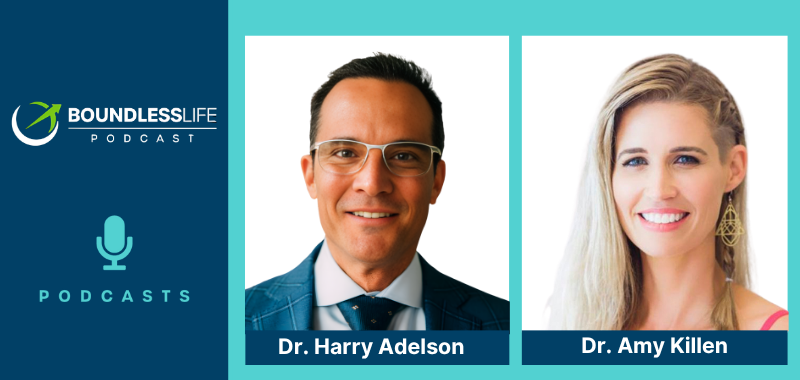
Stem Cells For Longevity & Performance: The Untold Truth About Domestic vs. International Treatments! With Dr. Harry Adelson and Dr. Amy Killen
Reading time: 6 minutes
What I Discuss with Dr. Harry Adelson and Dr. Amy Killen:
- Dangers about having to go overseas for state-of-the-art procedures, while most stem cell medicine is available in the US, except for culture expansion of donor cells…01:55
- What happens in stem cell culture expansion and why using unaltered (naive) tissue is safer and more biologically complete…04:08
- The distinction between stem cells harvested from your own bone marrow/fat (autologous) versus those from donated birth tissue (allogeneic)…07:15
- Recent state laws in Utah and Florida show that they clarify but do not override federal limits on culture expansion…09:41
- 361 HCT/P pathway involves strict donor screening, sterility, traceability, and oversight, making it the gold standard compared to international clinics…11:15
- How treating “busted up old cowboys” led Dr. Adelson to full body protocols using bone marrow and fat…14:27
- Dr. Adelson details multiple cases where overseas procedures led to catastrophic infections, including spinal damage and lifelong dialysis…16:16
- How the Full Body Stem Cell Make-Over® procedure, now condensed to about an hour, targets the spine, shoulders, elbows, wrists, hips, knees, ankles, toes, and brain for systemic benefits…25:32
- Skin rejuvenation, scalp injections for hair, face and neck treatments, and sexual health injections, plus IV stem cells…28:32
- Non-ablative Regenelase Laser, describing its dual modes (photobiomodulation & fractionalization) and Dr. Adelson's process for using diagnostic imaging for highly targeted treatment…31:17
- The role of exosomes, now called extracellular vesicles, which are isolated from stem cell cultures and used as potent regenerative signals…36:02
- The most effective biohacks for maximizing stem cell mobilization and recovery: red light therapy, HBOT, peptides, nitric oxide, and more…41:48
- New developments include therapeutic plasma exchange (TPE)—an “oil change” for blood—before the procedure, providing a molecular “deep clean” for the body, followed by massive stem cell support…44:29
In this episode, I sit down in Park City, Utah, with two trailblazers in the regenerative medicine space (and repeat guests): Dr. Harry Adelson and Dr. Amy Killen. They dive deep into the world of the Full Body Stem Cell Make-Over®—exploring what sets their innovative procedures apart, what actually happens during this intensive experience, and why you don’t need to cross any borders to get world-class stem cell treatments.
Together, they unravel common myths about stem cell therapy, clarify the legal landscape in the U.S. versus international clinics, and shed light on how these therapies could impact everything from joint recovery and longevity to skin, sexual health, and even brain function. You’ll also get a behind-the-scenes look at the safety protocols, sourcing, and advanced technologies—like laser activation and extracellular vesicles—that elevate their practice above the rest.
Dr. Adelson began his training in prolotherapy in 1998, during his final year at the National College of Naturopathic Medicine in Portland, Oregon. During his residency program at the Yale/Griffin Hospital in Derby, Connecticut, he volunteered after hours in a large homeless shelter in Bridgeport, Connecticut, providing regenerative injection therapies to the medically underserved while gaining valuable experience.
He opened Docere Clinics in Salt Lake City in 2002, and from day one, his practice has been 100% regenerative injection therapies for the treatment of musculoskeletal pain conditions. In 2006, he incorporated platelet-rich plasma and ultrasound-guided injection into his armamentarium, in 2010, bone marrow aspirate concentrate and adipose-derived stem cells, and in 2013, fluoroscopic-guided injection (motion X-ray).
Since February of 2010, Dr. Adelson has performed over 3,000 bone marrow and adipose-derived adult stem cell procedures, placing him among those most experienced in the world with the use of autologous stem cells for the treatment of musculoskeletal pain conditions.
A board-certified doctor in Emergency Medicine with 10+ years of direct patient care, Dr. Amy Killen has been practicing anti-aging and regenerative medicine for more than five years. She is fellowship-trained through the American Academy of Anti-Aging Medicine and has done extensive additional training in aesthetics, platelet-rich plasma and stem cells, hair restoration, bio-identical hormones, nutrition, fitness, and sexual health.
Dr. Killen is the Medical Director of BioRestoration Medical, a busy clinic with a comprehensive, integrative approach to health located in Draper, Utah. She also works at Docere Medical in Park City, Utah, with Dr. Adelson, providing cutting-edge regenerative medical treatments for a host of different conditions. She has spoken internationally about PRP and stem cells, as well as sexual longevity and skin health. She also teaches physician training courses, outlining current best practices for using regenerative medicine in aesthetics and sexual optimization.
For additional insights, you can check out my previous podcasts with Dr. Adelson and Dr. Killen, listed below:
- The Single, Most Comprehensive Stem Cell Procedure Known To Humankind: How A “Full Body Stem Cell & Exosome Makeover” Works.
- The Future Of Stem Cell Therapy, Making Fancy Stem Cell Protocols Affordable To More People Than The Elite Rich, Stem Cell Injection Secrets & Much More With Dr. Harry Adelson.
***Disclaimer: The information and content in this video are for informational and educational purposes only and are not intended as medical advice. Stem cell procedures are considered experimental in many contexts and are not approved by the FDA for all conditions. Always consult with a qualified healthcare professional before making decisions about your health, treatments, or medical care. ***
Please Scroll Down for the Sponsors, Resources, and Transcript
Episode Sponsors:
LeelaQ: Not only do LeelaQ’s products neutralize EMFs, increase ATP production, optimize HRV, and improve blood flow, but they've been third-party proven to do so in placebo-controlled double-blind studies. Visit LeelaQ and use code BEN10 for 10% off.
LVLUP Health: I trust and recommend LVLUP Health for your peptide needs as they third-party test every single batch of their peptides to ensure you’re getting exactly what you pay for and the results you’re after! Head over to lvluphealth.com/BGL and use code BEN15 for a special discount on their game-changing range of products.
Truvaga: Balance your nervous system naturally with Truvaga's vagus nerve stimulator. Visit Truvaga.com/Greenfield and use code GREENFIELD30 to save $30 off any Truvaga device. Calm your mind, focus better, and recover faster in just two minutes.
Ketone-IQ: Ketone-IQ delivers science-backed performance fuel that increases power output by 19%, reduces fatigue by 10%, and naturally boosts EPO production for better oxygen delivery—trusted by elite athletes like Jon Jones and Olympic champions. Save 30% on your subscription, plus get a free gift with your second shipment at Ketone.com/BENG.
Pique: Pique Teas is where plants and science intersect to produce teas and supplements of unrivaled efficacy, purity, and convenience. Go to Piquelife.com/Ben to get 20% off for life, plus a free starter kit with a rechargeable frother and glass beaker to elevate your ritual.
Boundless Bar: Fuel your body and brain with Boundless Bar—the world’s first goBHB®-powered protein bar designed for sustained energy, mental focus, and metabolic health. Made with collagen protein, nut butters, and clean ketones, it supports performance, recovery, and all-day vitality. Grab yours now at boundlessbar.com—and enjoy 10% off when you subscribe.
Resources from this episode:
-
-
-
- Guests
- Devices & Equipment
- Supplements & Peptides
- Rapid Rebound
- STEMREGEN (use code BEN to save 15%)
- Nitric Oxide Supplement
- BPC-157 (use code BEN10 to save 10%)
- Nitric Oxide
- Books & Publications
- Clinics & Manufacturers
-
-
Ben Greenfield [00:00:00]: My name is Ben Greenfield, and on this episode of the Boundless Life podcast.
Harry Adelson [00:00:05]: This is bad. I mean, first and foremost, it's clearly catastrophic for the patients and their families, but it's also bad for the whole field of regenerative medicine. You know, Ben, the take home message here is this kind of stuff doesn't happen in the U.S. welcome to the.
Ben Greenfield [00:00:21]: Boundless Life with me, your host, Ben Greenfield.
Ben Greenfield [00:00:24]: I'm a personal trainer, exercise physiologist and nutritionist. And I'm passionate about helping you discover unparalleled levels of health, fitness, longevity and beyond. I sat down with two super cool doctors to talk about the full body stem cell makeover and oh, so much more. Dispelling a lot of the myths and revealing a lot of the truths in the stem cell industry with Dr. Harry Adelson and Amy Killen. Recorded live in Park City, Utah. The show notes are at BenGreenfieldLife.com STEMCells2025 enjoy. I'm here in Utah with two of my favorite doctors.
Ben Greenfield [00:01:07]: This is the probably one of the fanciest things that I've kind of come across in the whole. I mean, it gets called the biohacking industry, but like the regenerative medicine space, the anti aging space, this whole idea of covering your entire body with stem cells. Not just covering, but like injecting the entire body with stem cells. And this is what you guys specialize in. I honestly don't know if anybody else in the world does full body stem cells.
Harry Adelson [00:01:34]: They don't. I think anyone's crazy enough to.
Ben Greenfield [00:01:37]: It's kind of weird because we're in Utah and like, the perception that I get is most people think like you go overseas, you go like Mexico or Lithuania or something like that to do the fancy stuff that you can't do in the U.S. do you get that also?
Harry Adelson [00:01:55]: Yeah. I mean, Ben, first of all, it was great to see you again. You know, this is, I think now your fourth full body Stem Cell Makeover.
Ben Greenfield [00:02:01]: I should probably mention, by the way, Dr. Harry Adels and Dr. Amy Killen.
Harry Adelson [00:02:06]: Oh, there's that too.
Ben Greenfield [00:02:07]: I'll put your long extended bios in the show notes. And the show notes are gonna [email protected] stemcells2025 stem cells. 2025. Okay, so the international versus domestic thing, what's up with that?
Harry Adelson [00:02:20]: Yeah, so you know, Ben, I guess my question is on what planet does an American citizen have to go south of the border to get a procedure of any sort?
Ben Greenfield [00:02:30]: I thought it was this one. Cause there's, like, rules about using your.
Harry Adelson [00:02:33]: Well, that's this common misconception that's getting pushed. And I mean, it's just. See, the thing is, we can do stem cell medicine here in the US but there's all these misconceptions about it. You know, the one thing that we can do internationally that we can't do here in the US Is culture. Expand the stem cells, grow the stem cells out in a laboratory. There's one big advantage to that, and that is it reduces the price. Beyond that, there's a lot of.
Ben Greenfield [00:03:04]: What do you mean it reduces the price?
Harry Adelson [00:03:06]: Because to procure the stem cells from a umbilical cord, for instance, is an expensive procedure. And you only get so many from a single umbilical umbilical cord.
Ben Greenfield [00:03:14]: So you could get less umbilical stem cells, a lower price than take them overseas and grow them.
Harry Adelson [00:03:19]: If you take them overseas and grow them, they become much less expensive. And that's the big upside.
Ben Greenfield [00:03:24]: Okay.
Harry Adelson [00:03:25]: There's a lot of downsides, however, when you grow them in a laboratory over and over, you get problems. You get genetic for fragility. You certainly can get contamination. There's a lot of problems that can occur. And a lot of these clinics are, you know, they're really incentivized to grow it out over and over to do many.
Ben Greenfield [00:03:44]: What's called passes. Micro revolution in general. Yeah, Passes like stem cell. Like, they'll brag like these are like four pass or poor generation or whatever.
Harry Adelson [00:03:51]: Right.
Ben Greenfield [00:03:51]: And I have heard more because I've interviewed some other folks in the stem cell industry and I have heard, like bits and pieces of this now that, no, you don't want to grow them because kind of like it's almost like microevolution. Right. Like if you breed yeast or fruit flies over a certain period of time, you tend to see a greater level of mutation.
Harry Adelson [00:04:08]: Exactly. Similar process and not passing them at all is preferred. And we can do that here in the US we can use umbilical. First of all, like, let's just back up for a second. So, you know, for years we used bone marrow and fat. There's two types of stem cells. Basically, there's stem cells from your own body, which is called autologous. Autologous means donor and recipient are the same person.
Harry Adelson [00:04:28]: You underwent two full body stem cel makeovers using your own bone marrow. You don't have enough fat. So we didn't use any fat. But with most people, we use fat.
Ben Greenfield [00:04:35]: I had a little bit. Quick, quick story. I know I keep Derailing you. But I actually harvested my fat to get my fat stem cells. This was years. I was 30 years old at the US stem cell clinic in Florida. So I had my fat stored there. And then I went to forever clinics in Berkeley also when I was 30, and I had my bone marrow stored there.
Ben Greenfield [00:04:53]: And then the first time I did it with you, you harvested my bone.
Ben Greenfield [00:04:58]: And.
Ben Greenfield [00:04:58]: And like you said, that's autologous. But from what I understand, it also kind of makes it a little less comfortable and increases recovery time to be tapping into your own body.
Harry Adelson [00:05:07]: Well, yeah, and we'll kind of go into the full deep dive about autologous versus allogeneic. But essentially, when we're talking about this allogeneic. And allogeneic means primarily it's birth tissue that's donor and recipient are different people. We're talking about from birth tissues, essentially, umbilical cord. This is not embryos. There's the baby, and then there's the birth tissues. And the birth tissues are the umbilical cord, the placenta, and the amniotic membrane.
Ben Greenfield [00:05:33]: And we'll come right out and say it. Cause I get this. This is not like aborted baby tissue. Absolutely. This is, like, straight up, just like, from the birth.
Amy Killen [00:05:39]: Yeah, just donate it.
Harry Adelson [00:05:40]: Yeah. So when a woman gives birth in a hospital, there's the baby and then there's the birth tissue, the birth tissues, the umbilical cord, the amniotic membrane, and the placenta. She's given three options what to do with the birth tissue. It can be thrown in the trash. It can be, she can keep it herself or she can donate it. And if she donates it, she gives up a version of her health records in a redacted format, which then whoever takes over the birth tissue gets possession of. So you don't see her name, you don't see her Social Security number. You just see all her health information.
Harry Adelson [00:06:12]: And then they do all sorts of testing on that. The big advantage of using naive meaning straight from the umbilical cord is that this is as nature intended it. This is the preservation of the entire biological integrity of the tissue. All the growth factors, all the cytokines, all the extracellular matrix, all the items that are responsible for helping a baby to grow.
Ben Greenfield [00:06:39]: But if you grow and expand naive tissue like umbilical tissue, do you still get all the growth factors and everything? But the disadvantage would be the potential for mutations, or does it also, like, dilute the good stuff?
Harry Adelson [00:06:49]: Well, you're just growing out the cells. You're not growing out the actual tissue. So you're not getting all of, for instance, the Wharton's jelly. You're not growing that stuff. You're just growing the individual or like.
Amy Killen [00:07:00]: The hyaluronic acid for. And that's a part of this tissue usually. And so when you expand just the cells, you'll get a bunch of stem cells, which is great. But you don't get, like, the extracellular matrix, the hyaluronic acid, the things that go around the cells and can help make the cells work better.
Harry Adelson [00:07:15]: And there are some situations where you want gargantuan quantities of cells, but for most longevity purposes, for most musculoskeletal pain conditions, most of the things that you and I are, you know, we're gonna be treating with you and your treatment, these are things that you achieve perfectly well with this.tissue.
Ben Greenfield [00:07:34]: And the fascinating history of this, by the way, for those of you listening, Harry gets into how he used to work with just like, beat up cowboys and ranchers here in the Utah area. I've interviewed him twice about that whole history. So check out the show notes and a link to those as well, because there's a really cool background behind how all this got started. But I kind of want to focus on some of the science today and also like the procedure itself and how that actually goes. But before we leave the domestic versus international piece, I've been hearing that it's now legal in certain states to actually expand the stem cells. Like Florida, I think, was one that I heard about.
Harry Adelson [00:08:11]: So it's really interesting because these laws. There's two states that have passed these laws. One is here in Utah and the other is Florida. So what you need to keep in mind is that state laws can never supersede federal laws. Okay, so imagine that you've got, like, dad, who's the disciplinarian, and he lays down the law and he's. And he sort of says what you kids can and cannot, but he's not real clear. And sometimes his language is a bit adult language. It's sort of hard to follow.
Harry Adelson [00:08:40]: And then you've got mom who brings the language down to the kids and tries to make it easier to follow the rules. That's kind of what's happening here, is the federal laws dictate what happens in the country, but the states are trying to provide guidelines to make it easier to understand and actually make it easier to be compliant. So these laws that have been passed in Utah and then also in Florida don't allow you to do anything that you aren't allowed to do federally. What it does is they clarify the rules in two regards. They clarify the rules about which types of manufacturers you can use, and they clarify the rules around informed consent.
Ben Greenfield [00:09:21]: What's a manufacturer?
Harry Adelson [00:09:22]: So a manufacturer are the laboratories that collect the birth tissue products, the umbilical cord, the amniotic membrane and the placenta. And they process those tissues, put it into vials for guys like me to used on guys like you.
Ben Greenfield [00:09:37]: Okay, so the states can clarify the nature of the manufacturer and the compliancy, but they can't based on these new regulations. Like take your own stem cells and expand them without getting into trouble.
Harry Adelson [00:09:51]: Well, taking your own stem cells and expanding them is legal nationwide. There's no new. These state laws don't allow for anything that is not allowed otherwise in all the other states. It just clarifies what it is, how it is that you can sort of follow the federal laws.
Ben Greenfield [00:10:10]: Okay, so I'm still confused though. Like, what's confusing? That's legal in Utah and Florida. That didn't used to be Nothing. Nothing. Okay, so some doctor can't move to either of these two states. There's no kind of a stem cell operation that could before?
Harry Adelson [00:10:24]: No, it does not change the regulatory landscape at all. It just clarifies the rules.
Ben Greenfield [00:10:30]: Okay, and then when you said that it is legal to expand your own stem cell tissue, but then you said one of the reasons you go international is to cult it, which I think is the same as expansion.
Harry Adelson [00:10:41]: That's the difference between autologous and allogeneic. When it's autologous, we are able to grow out your own stem cell.
Ben Greenfield [00:10:49]: I see. So it's legal to grow your own, but it's not legal to grow like somebody else's.
Harry Adelson [00:10:53]: And those laws actually come from like the abolition of slavery and having ownership of your own body. Yeah. So it's that the big difference there is your own cells. There are four main regulatory pathways for donated umbilical cord tissue to be brought to market in the United States. Each of these pathways has very clear rules on manufacturing, advertising and intended use. The first is the cosmetic pathway, which covers topical applications like serums or creams designed to improve the appearance or hydration of the skin. These products can't make medical claims and are for external topical use only. And it says so on the label.
Harry Adelson [00:11:33]: There's certainly not any intended use for like IV or something like that. And it can't be injected at all. Like no IVs, no knees, no. No needles. Next is the research only pathway these Products are labeled for research use only or not for human use. That seems pretty clear, doesn't it? They can't be injected or used on patients at all. They're meant for lab based study or product development or early research. Not at all clinical care.
Harry Adelson [00:12:03]: These are not okay to use on patients. If someone tells you they are, they don't know what they're talking about. Then there's the 351 biologic drug pathway, which we all know as the pathway to becoming an FDA approved drug. These products undergo full FDA approval through the investigational new drug and biologic license application process, which can take years of clinical trials to complete before they can be marketed for use in patients. There's currently no 351FDA approved stem cell products that have been brought to market. But there's a fourth pathway we have the 361 HCTP pathway. HCTP stands for Human cellular tissue based products. These products are regulated by the FDA and as such meet the strict standards for donor eligibility, sterility and traceability.
Harry Adelson [00:12:56]: They can be used in clinical settings for homologous use, meaning the product performs the same basic function in the recipient as it did in the donor, such as protecting, cushion or supporting the tissue. Basically the same functions we're trying to achieve in your knee. Ben. Of those four pathways to bring umbilical cord tissue to the market, the 361HCTP pathway is the only one that allows physicians in clinical practice in the United States to legally inject them without being part of a formal drug trial. Products that are 361HCTP registered meet the highest standard for donor screening, sterility and traceability. 361 HCT registered umbilical cord tissue products are produced in FDA registered, CGMP certified and hopefully American association of Tissue Banks accredited facilities. What this means is that Every vial of 361HCTP registered umbilical cord tissue products can be traced back to its donor. Every lot is tested for contamination and every process is validated.
Harry Adelson [00:14:06]: When you compare that level of oversight to what's being offered south of the border, I mean, there is no comparison.
Ben Greenfield [00:14:12]: Geez. Okay, so back to finishing what you were saying about the idea of using the. How would you pronounce that? Allogeneic.
Harry Adelson [00:14:24]: Allogeneic.
Ben Greenfield [00:14:24]: Like using the allogeneic tissue versus the autologous. Any other advantages or reasons that you would do that versus what you used to do, which was taking the bone marrow and the fat?
Harry Adelson [00:14:34]: Well, so you know, remember the story. So I for years did autologous I did bone marrow and fat. And you referred me one of your patients, one of your movie star patients who came to me. We did a autologous treatment. We used his bone marrow and fat. He did great. He had a great outcome. He was very happy with it.
Harry Adelson [00:14:49]: He called me back and he said, I tweaked my back doing stunts for my movie. I need to get back in, but I can't afford the downtime associated with the tissue harvest. Will you consider doing it with birth tissue cells? And I said, well, I won't promise that I'll do it, but I'll promise that I'll look into it. So I sort of did a deep dive. This was about four years ago. I did a deep dive in the literature. Hadn't done, hadn't really looked at the allogeneic literature in a while. And there had been a great deal more published on the safety and efficacy.
Harry Adelson [00:15:20]: So I felt good about using it. So we did a full body stem cell makeover on him using birth tissue products. And the outcomes were. I was very happy with the outcomes. I was very happy with how much easier it is to go through.
Ben Greenfield [00:15:32]: It was way easier. I did the original the O and then I did the, the new one. Yeah, well, like, I think it was one or two years ago. Yeah. And now I'm doing the new one again tomorrow just because I love you guys so much. And I beat myself up so much and I do feel kind of beat up for like a week after. And then my body starts to like ramp up and feel incredible afterwards. And maybe we can talk later on about the recovery and performance and even like the, the sexual and the aesthetic implications.
Ben Greenfield [00:15:59]: But back to the, like the domestic versus international piece. What would be, if any, like, the reasons that someone wouldn't go international besides the potential for mutated cells? Like, are there any other concerns or anything like that?
Harry Adelson [00:16:16]: Well, you know, anytime you leave the U.S. you're leaving the U.S. so. Yeah, you know, I mean, there's.
Ben Greenfield [00:16:23]: I've done blood filtration in Tijuana. Yeah.
Harry Adelson [00:16:26]: Yeah. I mean, if anything, if anything goes wrong, you're basically on your own. And, you know, unfortun, you know, I don't want to go into great detail about this, but I will just mention that there is a well known stem cell doctor who has been treating people overseas or south of the border, I should say. It's about to hit the news. I'm aware of two serious, serious bad outcomes, but allegedly there have been close to 20. And I don't want to throw stones. I don't want to cast stones. I don't want to get heavy into it.
Harry Adelson [00:16:58]: But it's going to hit the news.
Ben Greenfield [00:16:59]: That could happen in the US Right?
Harry Adelson [00:17:02]: Not in the way that it's happened down there. Because what was being in all of these patients, allegedly. And the truth will come out and we're gonna find out all about this, but the bacteria that was being cultured out of these people who are having these massive infections was coming from tap water. And that's not something that you normally find in people in an infection. So, you know, like, again, he looks intrigued.
Ben Greenfield [00:17:26]: You mean like there would be like tap, like, like tap water in the procedure?
Harry Adelson [00:17:30]: Well, we don't know. I mean, that's examination. We know of some patient, like I personally know some patients who have, who have shown me their pathology reports that showed this bacteria that's endemic in laughing water.
Ben Greenfield [00:17:43]: They couldn't just get that from like drinking the water and.
Harry Adelson [00:17:46]: Not in your blood. Not in your blood. Yeah, not in your blood.
Amy Killen [00:17:49]: So contamination is the big concern.
Harry Adelson [00:17:51]: Yeah. With some type of contamination. And we're talking about serious complications here, you know, not minor hiccups, complications that permanently alter the trajectory of people's lives. You know, I feel the need to say that I'm not just repeating back gossip that I've heard. This isn't just hearsay. These are patients and doctors. I've had direct conversations with. One of the patients I know personally, he's a major health influencer.
Harry Adelson [00:18:16]: He's been a patient of mine. I'm also friends with the two spine surgeons who took care of him while he was in the hospital dealing with this infection that pretty much almost killed him. His infection was in his spine and it completely destroyed his spine. He ended up getting spinal fusion because of the damage done by the bacteria. The other patient that I do have direct knowledge of was referred to the same south of the Border clinic by a doctor who's a longtime friend of mine. My doctor friend told me that the infection destroyed his patient's kidneys. And this guy's going to be on kidney dialysis the rest of his life. I do not have direct contact with the alleged other 20 or so infections from that same clinic.
Harry Adelson [00:18:56]: That part is hearsay, but only once removed. So, you know, the truth will come to light. But this is bad. I mean, first and foremost, it's clearly catastrophic for the patients and their families, but it's also bad for the whole field of regenerative medicine. You know, Ben, the take home message here is this kind of Stuff doesn't happen in the U.S. i mean, seriously, if you want to get treated, just stay home, for crying out loud. We can do it here in the good old US of A. And it's not worth the risk of going south of the border.
Harry Adelson [00:19:25]: You know, I strongly believe in medical freedom. I don't think we need to throw the baby out with the bathwater when we're talking about like some degree of oversight by the government. Yes, you know, the fda, for all its foibles and for all we like to complain about it, like, they do a lot of great good as well as far as protecting the public health of people.
Ben Greenfield [00:19:47]: So the other thing I think some people might still think is that there's some kind of, like, illegality associated with even like the allogeneic. I keep wanting to say allogenic. How's it spelled?
Harry Adelson [00:19:59]: A. You actually can say either.
Ben Greenfield [00:20:01]: Okay, I'm gonna say allogeneic. Follow your lead. Is there anything people have to worry about as far as legality with these?
Harry Adelson [00:20:09]: If it's done correctly, there's really no gray area, and I'm gonna talk more about that. But sort of the four the think you have to go abroad. First of all, there's these influencers who are conflicted, who are telling you that you have to go abroad. There's guys who, we all know them and they are either getting sort of endorsement payments or they are owners of international clinics. And they're the ones up there saying you have to go abroad to get the good stuff is what you hear a lot. You have to go abroad. And that's just simply not true. Another big reason is all of these therapies using birth tissue products is not FDA approved.
Harry Adelson [00:20:49]: Now, just because something is not FDA approved doesn't mean we can't do it. It just means we can't talk about it as if it's FDA approved.
Ben Greenfield [00:20:57]: Right. Like peptides aren't FDA approved.
Amy Killen [00:20:59]: Like supplements.
Harry Adelson [00:21:00]: Also, if something not being FDA approved meant you couldn't do it, the entire nutritional supplement industry practically wouldn't exist.
Ben Greenfield [00:21:07]: Right. But you can't claim that, like this joint recovery product cures arthritis, but you can say supplements.
Harry Adelson [00:21:13]: You can't make metabolic joints. Exactly. That's exactly right. It's not FDA appro. But we can. It doesn't mean it's illegal. It just means we can't give people the impression that it's FDA approved. Insurance doesn't pay for it.
Harry Adelson [00:21:25]: Now that doesn't mean anything one way or the other. It just means insurance doesn't pay for it. Why doesn't insurance pay for It? I have on my website a book, a little book that I wrote, and I've got an entire chapter. The title of the chapter is, if Stem Cell Medicine is so Great, why Doesn't Insurance Pay for It? It's a complicated issue. Have a look at my book if you want to see it.
Ben Greenfield [00:21:43]: Well, send me books.
Harry Adelson [00:21:44]: The Stem Cell solution. It's all my website. Yeah. And it's, you know, it's a complicated story, but it's all about money moving hands.
Ben Greenfield [00:21:53]: Okay.
Harry Adelson [00:21:54]: And then, you know, and then the last reason is there are bad actors in this industry. There are people who do get in trouble either for using, you know, product they're not supposed to be using or for making claims and they get into trouble. And that does draw a lot of attention.
Ben Greenfield [00:22:07]: Okay. Okay. I think that's pretty clear. Now you brought up manufacturers, obviously. I'm assuming that must be important, like where they're actually coming from. How's that work? Like, how do you decide where you're going to get your cells and then what do you use?
Harry Adelson [00:22:23]: Amy and I are using vidilabs. Vidilabs are true manufacturers and function very much outside of the gray area here in the United States. Something that people don't realize is that a lot of doctors are buying their product from distributors or private label companies that don't actually make the product themselves. These distributors, someone else to manufacture their product for them. And what that means is they don't have any sort of oversight of donor procurement, processing or quality control. We want to work directly with the manufacturer because we want complete transparency and control over what it is that we put in people. Every vidi product is FDA registered as a 361 human cellular and tissue based product. Their facility is American association of Tissue Banking accredited and they operate under current good manufacturing pract certification.
Harry Adelson [00:23:14]: A lot of companies say they follow the guidelines of those organizations, but Vidi actually goes through the annual inspection of the third party audits, the whole shebang. Let me go back and explain some of those terms I threw around. Vidilabs is FDA registered. Now, a lot of labs are FDA registered. But what people don't realize, it's not enough for the facility itself to be registered. Every single product that comes out of vidilabs is individually listed and registered. Everything we use in our treatments, the umbilical cord tissue and the extracellular vesicles are FDA registered and listed. That's an important point because it's actually quite easy for a facility to register itself it really just means they fill out a form and paid a fee.
Harry Adelson [00:23:59]: But Vidi goes through the whole full registration and listing process for their specific products, which is hugely arduous. And it means the FDA has a record of all the donor screenings, disease testing, sterility, and is able to trace every single batch. They're CGMP certified. CGMP is current Good Manufacturing practices. CGMP certification means the facility operates at the same level of control as a pharmaceutical manufacturer. Every step of production is validated, monitored and repeatable. That means every vial is consistent, sterile and safe. You know exactly what you're getting.
Ben Greenfield [00:24:39]: So I think go time is 9am tomorrow. I'm sure people are wondering what the actual logistics of this are. And before we even jump into what we're gonna start into, like what happens at 9am tomorrow, I think it's important to clarify like why somebody would actually even think about doing this in the first place. I'll come right out and say that. I think like the joint, joint recovery, joint treatment stuff is pretty obvious. And I've talked about that a lot before on the podcast, like beat up knee, beat up back, beat up joints. Stem cells certainly help with that. Are there other reasons besides just like general joint pain that somebody does something like this?
Harry Adelson [00:25:19]: Well, you know, this all started, you remember when we talked about this in other podcasts. This all started when I first started doing bone marrow stem cells back in 2010. Nobody had heard of it because it wasn't cool yet. The only people who had really heard of it were Wyoming cowboys and ranchers because they were having it done to their horses. Doctors in the United States to do any kind of stem cell medicine were veterinarians. So these Evanston, Wyoming cowboys had these expensive workhorses that were getting too old to work. They'd take them to this veterinarian. The veterinarian would do bone marrow stem cells on the joints and their hooves and they get two or three more years of work out of them.
Harry Adelson [00:25:54]: Well, they would see this with their eyes and they would like ask this vet, they'd say, well, you know, can you do that to my spine and my shoulders and my hips and my knees? And the guy would say, well, no, I can't because I'm a veterinarian. But there's a guy in Park City now. Go to him.
Ben Greenfield [00:26:07]: So in those early war cyber and.
Harry Adelson [00:26:09]: Fenbezzedol on Amazon, he would refer em to me. And back in those days, I was happy to get these referrals and I'd get these guys and they just literally had arthritis through their whole bodies. Cause they're busted up old cowboys. And so I'd do their whole spine and I'd do their shoulders and I'd do their hips and I'd do their knees. And that's about the time that I met you. And I started getting the longevity crew, the biohackers and that sort of thing. And people would come to me and say, hey, well, could you just do my whole body in a single sitting? And I thought about it and I thought, yeah, I mean, why not? You know, I personally am from the Mick Jagger school of anything worth doing is worth overdoing. If you're gonna make the trip, if you're gonna spend the money, if you're gonna do the stuff, we may as well just do a massive treatment.
Harry Adelson [00:26:53]: So we do everything under IV sedation, put the person asleep, do their entire spine, which is important.
Ben Greenfield [00:26:59]: Cause this is how many hours?
Harry Adelson [00:27:01]: It's an hour. It's one hour now.
Ben Greenfield [00:27:02]: Oh, it's one hour.
Amy Killen [00:27:03]: It's condensed.
Ben Greenfield [00:27:03]: Oh, I thought it was.
Amy Killen [00:27:04]: It used to be.
Ben Greenfield [00:27:05]: For some reason it feels like it was longer either.
Harry Adelson [00:27:07]: Okay, I do the entire spine if they're intervertebral discs if they need it. I don't do discs if they don't need it. But otherwise we do epidurals in the spine. Stem cell epidurals, facets the entire length of the spine. Flip em over both shoulders, both elbows, both wrists and thumbs, both hips, both knees, both ankles and toes. I also do a sphenopalentine ganglion injection.
Amy Killen [00:27:27]: This is a new one.
Harry Adelson [00:27:28]: Yeah, this is a new one that I've added since that you'll get for the first time tomorrow, which is the sphenopalatine ganglion is the fifth cranial nerve. So it's a way to get the extracellular vesicles and the cel effectively into the brain. If you look up nose to brain stem cells, another way to do it is aerosolize through the nose. I do it as an injection. It's a little further upstream on the fifth cranial nerve. And it's more accurate and more direct.
Ben Greenfield [00:27:54]: Yeah, I did stem cells in the nose once.
Harry Adelson [00:27:56]: Well, you're gonna get it.
Ben Greenfield [00:27:57]: Lights went on in the brain. Not my lights are off. But it felt like stuff got a little brighter. That's super interesting. I didn't know you added that. Yeah. Okay.
Harry Adelson [00:28:04]: So, well, and then Amy does go.
Ben Greenfield [00:28:06]: To the mental piece piece, the joint issues piece. Amy, you've got the.
Amy Killen [00:28:11]: Then it's my turn. So I do I know, I have been quiet. I do what I call sex and skin. So I'm doing your skin, obviously. Face, usually neck, upper chest. I do scalp as well to try to improve hair growth and quality of hair. And then I do the sexual injections at the end, as you know. And then still under anesthesia, you're still.
Amy Killen [00:28:32]: Yeah, that's the one that everyone's always. That's like the most important one for being asleep. Although it's actually, I've done it without anesthesia. It's not that painful even then. And that's it. I always do some IV stem cells as well. And then we wake you up and all that happens in about an hour.
Ben Greenfield [00:28:44]: Okay. I want to dig into a few of the nitty gritty.
Harry Adelson [00:28:47]: And when you're talking about South America, just as the last thing, when you're going to South America to get those culture expanded cells, you're getting this gargantuan number, but you're mostly just getting at iv. You might get your knees, you might get your back, a couple of things. Nobody's doing this.
Ben Greenfield [00:29:02]: What's the IV part for?
Amy Killen [00:29:03]: Just general health. And the idea being that stem cells can kind of home to areas of inflammation. And in theory, and they can, but a lot of them, when you put them in an iv, get trapped. The cells themselves, part of them will get trapped in the lungs. So it's good to do both IV and the actual joints and things.
Ben Greenfield [00:29:23]: Would the IV also affect organs?
Harry Adelson [00:29:25]: Well, that's mostly going to go to the organs because they're just going to follow the laws of hemodynamics and fluid dynamics. So they're mostly going to go to the organs, but they're not going to go to your knees and your shoulders and certainly your intervertebral discs. So if you're getting at iv, you're hoping some of it gets to your musculoskeletal structures. When we do it in the musculoskelet skeletal structures, they exert their primary action on those structures. Then they get picked up in general circulation.
Ben Greenfield [00:29:48]: So that's why it would be interesting for someone who was pursuing anti aging or longevity would be. Of course there's the joint piece, but then the infusion and then the brain injection would help out with neural and full systemic coordinate function. Or at least almost like a regeneration or regenerative medicine for full body.
Amy Killen [00:30:07]: Yeah, that's the idea.
Harry Adelson [00:30:08]: We're hitting all the moving parts.
Ben Greenfield [00:30:09]: Parts. Okay, so when, when I go in there at 9am I remember the past couple of times, I like Count down. And then I just wake up in a chair. So when I fall asleep, are you guys just like starting at a specific spot and the needle goes in or like, is there any other pieces of machinery or special things involved here?
Harry Adelson [00:30:31]: Well, we're, you know, so we do the same. We do it exactly the same way every time. And that's a. It's. It's sort of like Amy and I.
Amy Killen [00:30:38]: Terry is like a switch, a Swiss watch. Like, like, he's very, very. It's very regimented. It's very like the syringes are lined up like perfectly.
Ben Greenfield [00:30:46]: That's what I want. If someone has a bunch of needles in my body, the work of art, I want to be dialed. Yeah, yeah. Not what the spirit inspires you to start with that morning.
Harry Adelson [00:30:55]: That's right.
Ben Greenfield [00:30:55]: Okay, good.
Harry Adelson [00:30:56]: That's right. Yeah. No, it's exactly the same way every single time. The one thing that we are starting to do different. You know, I mentioned to you about the sphenopalentine injection. I am bringing in the regenelase laser, which is a very sweet new laser. And you're gonna get that tomorrow. It functions on sort of two pathways.
Ben Greenfield [00:31:17]: Yeah, explain this, because most people's experience with lasers is like people getting blown up in movies.
Harry Adelson [00:31:21]: Yeah, this is totally different. This is a non ablative laser. So this is more like what you would when you go to the spa and you get a laser facial treatment. So there's two settings on this laser. There's the photobiomodulation. Photobiomodulation. What that does is it actually you're able to activate a cell so that the mitochondria produce more ATP, which is how a cell sort of gets energized. So there's sort of two ways that we use the photobiomodulation.
Harry Adelson [00:31:50]: We put the cells that we're gonna use in a clear plastic bag and we pass this laser over those cells to activate the cells. Then as we're injecting you, you'll see in the video that we're gonna show, I'm gonna like, for instance, go down your spine and right after I inject, follow right where I injected with the laser in order to activate these cells. That's the photobiomodulation aspect of this laser. The other mode of this laser is a fractional laser. So just like you use like a fractional non ablative laser on somebody's face, you're passing the laser over the face. And what that does is it doesn't impact the skin, but it creates this. It's called a coagulation. It's these micro channels that go down into your skin.
Harry Adelson [00:32:36]: And what that does is it creates, it causes the growth of new collagen to increase the elasticity of your skin.
Ben Greenfield [00:32:43]: That's for the face.
Harry Adelson [00:32:44]: That's for the face. But what we can do with this laser is we can actually use a fiber optic cable and use this laser. So with you, we're gonna put it in. You have a little bit of arthritis behind your left kneecap.
Ben Greenfield [00:32:57]: I sent you my full body mri, which is great. I've never had one of the. I've never had that in hand to like send you beforehand. And I got it a couple months ago in LA la. And there's a bunch of issues on there. And I think this is what a lot of people don't realize with like diagnostic imaging is you can see a ton of crap in there that freaks you out. But a lot of times you're asymptomatic. Like, my back looks lit up like a Christmas tree.
Ben Greenfield [00:33:20]: I've got a strong. Unless I'm sitting on a plane for like five hours and I forget to stand up and stretch or I'm just basically like sitting for long periods of time. As long as I keep my core strong and I do a lot of walking, my back feels fine. My right knee shows arthritis. My right knee's fine. My neck shows arthritis. My neck feels fine. But that left knee is probably like 85%.
Ben Greenfield [00:33:43]: And that one also shows.
Harry Adelson [00:33:45]: I'll take a little credit having done the three full biceps. I'll makeovers prior because that's the thing that's confusing is your diagnostic imaging can look terrible, but the person can have very little pain. And that's the thing that's quite amazing is how bad it looks on imaging. Doesn't actually even predict whether the person has pain to begin with. But your left knee is symptomatic. Your left knee is bothering you. And we do see on Mr. Both from your old Mr.
Harry Adelson [00:34:10]: From 2021 and this more recent full body Mr. You do have arthritis behind your kneecap. So what we're going to do is we're going to put an 18 gauge needle right behind your kneecap. Then I'm going to thread this fiber optic cable through that needle so we're able to bring that laser directly into contact with the back of your kneecap. And that's going to do the same fractionalization that you would do even with some skin.
Ben Greenfield [00:34:38]: Yeah. That's incredible.
Amy Killen [00:34:39]: That's pretty cool.
Ben Greenfield [00:34:39]: That's new. And by the way you're going to have a video camera in there because geeked out people want to see this. Oh, for sure. Again, the show notes are BenGreenfieldLife.com STEMCells2025 I'll embed the videos in there. Probably. I don't know if they're safe for work or not, but, but check, check out the videos. I'll put them in there.
Harry Adelson [00:34:55]: We'll blur out your butt.
Ben Greenfield [00:34:56]: By the way, like I gotta just come around and say this because, because I get this. A lot of times people are like, oh, you're the biohacker. Why the heck do you have like arthritis and all this crap going on your full body mri? I don't talk about this a lot on the podcast anymore, but from starting my college tennis career at 15 years old, all the way up through 17 years of Ironman triathlon, adventure racing, Spartan tough mudder obstacle course career, like basically every day it was like a masochistic suffer fest. I don't know if you guys have treated other people who have done a bunch of crazy endorsements and how many.
Harry Adelson [00:35:30]: Rest days did you have?
Ben Greenfield [00:35:31]: Yeah, now I'm sane. But yeah, I mean like I literally. Oh, rest days were not even in my vernacular. Right. Yeah. Until I was basically like 37 years old. Right. So yeah, I mean I, I haven't lived this like nice longevity infused, blue zone style lifestyle for, for my entire life.
Ben Greenfield [00:35:47]: What about another thing that people bring up a lot when they're talking about stem cells as exosomes and they say they help the stem cells signal or go through the body in a better way. Do you use those?
Amy Killen [00:36:02]: Yeah, I mean, yeah, we do. We've been using exosomes for a long time. We were kind of early adopters back before they were cool.
Harry Adelson [00:36:07]: We tend not to call them exosomes just because the word exosome is in the vernacular of pharmacological drugs. So we tend to call them extracellular vesicles. But it's the same thing.
Ben Greenfield [00:36:15]: Yeah, okay.
Amy Killen [00:36:16]: UVs. And they're essentially these little just. I call them like little bubbles of information. Like they're. One of the ways that stem cells communicate with other cells is they release these little bubbles of information that contain things like microrna and cytokines and growth factors and essentially messages. Host cell then can grab and pick up and then those exosomes can essentially change how that host cell is behaving. It can change how the proteins are being made and you know, you can act, it can act more youthful just because of these exosomes. I'm sorry, EVs.
Amy Killen [00:36:46]: Just because of the EVs. And so, you know, you can use these EVs by themselves, like, or you can use them in combination with the other stem cell products like we do and kind of get the benefits of both.
Ben Greenfield [00:36:56]: Are they coming from the same umbilical tissue or do. Or the same manufacturer or what happens?
Harry Adelson [00:37:02]: Absolutely, yeah. So it. They're derived from the mesenchymal stem cells from the umbilical cord tissue. So they take. The way they manufacture them is they have these umbilical cord mesenchymal stem cells and then they sort of stress them out. So they produce all these exosomes and then they centrifuge them out, separate them out. So we tend to use both and mix them together. And we just feel the extracellular vesicles are the actual messenger.
Harry Adelson [00:37:31]: It's the actual proteins that signal the whole paracrine effect. How regenerative medicine works.
Ben Greenfield [00:37:38]: Yeah. You talked about how they'll screen the mom who this birth product is coming from.
Harry Adelson [00:37:45]: All non Covid vaccinated mothers.
Ben Greenfield [00:37:47]: You read my mind. I didn't talk to you about this beforehand, by the way. I get that a lot. Like people like all these procedures that you're doing. Do you know if these people have been vaccinated? Because the MRNA can hang around the tissue. So even that gets.
Harry Adelson [00:38:01]: Yeah, yeah. They only accept from non Covid vaccinated. It's only for mothers who give cesarean section births because it has to come if once you go through the vagina it gets contaminated because there's bugs in there.
Ben Greenfield [00:38:12]: So it's cesarean section neighbor's hygiene and microbiome. But not good if you're using those.
Harry Adelson [00:38:16]: Exactly, exactly. But it's only non Covid vaccinated mothers. And that's, you know, documented through and through.
Ben Greenfield [00:38:21]: Okay. When I've done this in the past, I've. And I kind of hinted at this earlier, I noticed that after some of the post procedure soreness wears off, I start to recover better. I have more energy, my sleep improves and my sexual performance improves. Like those are the main things that I notice. What else do you guys get people talking about after something like this?
Harry Adelson [00:38:47]: I'll be really curious with this one after we do this phenylpalatine injection to hear because that.
Ben Greenfield [00:38:51]: Especially for the mental piece. Yeah, you bet. Yeah, you bet. Quit drinking coffee.
Harry Adelson [00:38:57]: You know, I mean, we get two types of people. We get people who have lots of musculoskeletal pain and we get people who don't have much at all who are doing it more just sort of for the longevity play. It's a lot easier to. It's a lot less subtle when somebody has a lot of pain because they have low back pain now they don't have low back pain. They have neck pain now they don't have neck pain. I mean, that's clear. When you get the people who are more doing it for longevity purposes, it's more subtle stuff like that. We get people telling us.
Harry Adelson [00:39:23]: And again, we don't help everybody, you know. And again, I'd like to just like, re. Emphasize none of these procedures are FDA approved. This is all completely elective. This is all like, we think it makes sense. And I've done a lot of these.
Ben Greenfield [00:39:35]: Proceed at your own risk. Harry's not a dog. He just wears the T shirt.
Harry Adelson [00:39:40]: Well, ask Chris Centeno. According to Chris Santano. I'm not a doctor.
Ben Greenfield [00:39:44]: According to who?
Harry Adelson [00:39:45]: Chris Centeno. He's an old friend of mine.
Ben Greenfield [00:39:47]: Oh, is he?
Harry Adelson [00:39:48]: Yeah.
Ben Greenfield [00:39:48]: All right.
Harry Adelson [00:39:50]: So anyway, so it's any number of things. Sleeping better, wearing their reading glasses. You get the loudest reviews with.
Amy Killen [00:39:57]: I mean, for me, sexual health, I think especially men especially this is a big fan favorite. And then, you know, I think improvements in skin quality is also something. And skin and hair both. We're not gonna. It's not a facelift if you're not going to look different, but it's just the improvement in, like, the glow, like how well rested you look, the pigment, the fine lines, things like that. And just kind of helping to age a little slower in the skin and hair area.
Ben Greenfield [00:40:21]: Yeah. And it's my understanding that there are certain things that help with. I don't know if the right word is stem cell mobilization or stem cell health, but like, I was having a conversation, this was about a month ago, and these two guys did a stem cell procedure. Not here. I think it was one of the overseas one. And one of the guys, he felt great afterwards, and his buddy noticed, like, nothing. And then we started talking, and his friend was just like, drinking alcohol, going back to his old lifestyle, Hopped on a plane right after, didn't pay attention to nutrition. You know, all of these things that I think are big, obvious points when it comes to.
Ben Greenfield [00:41:00]: To putting a bunch of, like, fresh, fragile baby cells into your body that might not be great for things like the inflammatory.
Harry Adelson [00:41:07]: It doesn't work if you're a drunk. It doesn't work if you're a mess.
Ben Greenfield [00:41:11]: So I think those things are obvious. But what about now that we're in this new era of biohacking things like let's say somebody's listening. Okay, I'm gonna do this, but I wanna get the most out of it. What are some things that people could do after getting a stem cell procedure or anything with stem cells that would help them to work better? Better?
Amy Killen [00:41:30]: Well, we like a lot of different things. Red light therapy. So photobiomodulation, the big like a red.
Ben Greenfield [00:41:35]: Light bed, red light panel. Ask any of that and I'm traveling. I might interrupt as you go through some of this.
Amy Killen [00:41:40]: Yeah, they're awesome.
Ben Greenfield [00:41:40]: I brought like a portable little red light mat and I also found a guy locally who's got like a, it's like a stand, a big stand up red light chamber.
Amy Killen [00:41:46]: Oh, there you go.
Ben Greenfield [00:41:47]: So I'm gonna do that.
Amy Killen [00:41:47]: Yeah, red lights, I mean red light we know increases stem cell, stem cell mobilization, proliferation signaling, you know, it does all. And the ATP and the mitochondria. So it's got a lot, a lot of benefits there. Hyperbaric oxygen is another one that is great for stem cells.
Ben Greenfield [00:42:01]: I'm one of those too.
Amy Killen [00:42:01]: And getting. Yeah, I'm sure you have some. What thats. There are some supplements and peptides that we often will use. Like we give everyone some. A peptide combination. That was actually one I created years ago. Yeah, yeah.
Amy Killen [00:42:13]: It's called rapid rebound. It's a BPC157AOD9604 and palmityl ethanolamide pea, which is anti inflammatory. So it's those three things as an oral combination. I created it years ago just kind of for fun.
Ben Greenfield [00:42:27]: You're one of the first people I've interviewed who can pronounce what PEA is.
Amy Killen [00:42:30]: Oh yeah.
Ben Greenfield [00:42:31]: To say pea I came.
Amy Killen [00:42:34]: So we give people that to take home with them because that really we think hastens healing and improves, you know, blood flow and things like that. Certainly avoiding alcohol. Don't smoke, like just being healthy is really important and we screen for that.
Harry Adelson [00:42:45]: Before common sense rules the day. I think so much of it is just common sense. Yeah, alcohol is the most inflammatory thing you can engage in. I mean it really just spikes your systemic.
Ben Greenfield [00:42:57]: That's a biggie. I, I, I like, I'm, I'm on the fence about like a small glass of organic biodynamic wine or something like that. But the way that most people drink.
Harry Adelson [00:43:07]: Yeah, that's a small glass is very different from alcoholic beans.
Ben Greenfield [00:43:11]: My, my people come to my house and make them a cocktail and they're like they can put any alcohol in that and, and it like I literally use like half an ounce of alcohol. So we really do microdose at the green.
Harry Adelson [00:43:19]: That's not how I do too.
Ben Greenfield [00:43:20]: Yeah, this is like for a little bit of extra flavor. What about p. I hear a lot about PEMF and its effect on stem cells or its ability to help with stem cell mobilization.
Amy Killen [00:43:29]: I mean it can be certainly very anti inflammatory and we've used it in other places, other clinics just to help with healing in general. I haven't seen it, studied myself for stem cell procedures. I don't know if you have.
Ben Greenfield [00:43:41]: It came up on a podcast like three years ago and somebody did show me some research that showed that it can help with mobilization. It wasn't like a post stem cell procedure thing, but yeah, it apparently has some kind of effect that makes sense. Like red light, oxygen and PEMF are all going to affect cellular function, mitochondrial health. You throw in some of the peptides and you guys have like a. Isn't like a botanical or something like that that you use like a blend capsules?
Harry Adelson [00:44:06]: It's the nitric oxide.
Amy Killen [00:44:08]: Oh yeah, nitric oxide, which is also great for stem cells. That's another one that's really good for improving stem cell mobilization and sickness signaling. You know, nitric oxide is obviously important for blood flow. It's a vasodilator. So it's getting blood flow to different areas and levels of goes down as you get older. So you can't make as much as you get older. So we do do.
Harry Adelson [00:44:26]: Nathan Brands, Nathan Brandt's comma, you're in Park City.
Ben Greenfield [00:44:29]: So for people who suffer from the altitude issues, I had beets for dinner last night. So now before the procedure, I've talked to some doctors who will do, you know, some kind of like Myers cocktail. Others will do nad another one does like blood ozonation. You were telling me in the car, drive down Harry, that you're gonna start doing the oil change for the body thing like beforehand.
Amy Killen [00:44:58]: Yeah, in the past we've done EBO2, which is the, you know, it's kind of like the ozonation with light and filtration of the blood. And now we're starting tpe, which is therapeutic plasmapheresis or plasma exchange. And super excited about that because there's some really cool immersion research that's come out in the last five or six years around tpe that is like super exciting. So we can't wait to do that one.
Ben Greenfield [00:45:23]: Why would you do it? Is it just like to put the stem cells into a cleaner environment?
Harry Adelson [00:45:27]: Precisely, precisely. So what TPE does is you're actually removing, you're taking blood out of the body. You're separating the cellular component, which is the white blood cells, the red blood cells, the platelets, putting those back in and cleaning off the serum. And the serum is where we collect microplastics, we collect cholesterol. It's where we collect inflammatory gunk that we just don't want in there. And there's not really a good way for your body to get rid of it, you know. And then the idea is people come in one week, do two therapeutic plasma exchanges 48 hours apart. Then, you know, the therapeutic plasma exchange does its magic thing.
Harry Adelson [00:46:06]: We remove all the microplastics and stuff from your serum. Then the following week, we do the full body stem cell makeover and supplement with this gargantuan dose of birth tissue.
Ben Greenfield [00:46:17]: Extracellular vascular, and we're doing a procedure on a Friday. I didn't schedule my plane flight home until Sunday, so I think it's a good idea not to hop on a plane right after either.
Harry Adelson [00:46:27]: Not the next day. Certainly.
Ben Greenfield [00:46:28]: Certainly encourage that.
Amy Killen [00:46:29]: Yeah, Just resting is really nice afterwards.
Ben Greenfield [00:46:31]: And leading up, I'll admit I didn't want to waste this procedure because it's a pretty big deal. So the past couple of weeks, I've been super careful with alcohol. I've done multiple hyperbaric chambers. I don't have ozone, like blood ozone at my house, but I've actually done a few ozone enemas leading up to this. I've been super good with the diet. I actually had a client at my house for the past weeks, and he, he was doing a detox, so I was just kind of like doing it along with him. So I'm coming in, hopefully pretty clean. And my hotel room is like a little biohacking facility right now.
Ben Greenfield [00:47:03]: I've like, I'm not BMF mat, red light mat. I got NormaTec boots. I've got all my little like, stem cell mobilizer capsules. Stem regen.
Harry Adelson [00:47:14]: That's right.
Ben Greenfield [00:47:15]: Yeah. So I have some stem regen. I brought BBC 157, but apparently you've got it. Who got it? And so, yeah, and then I had to down a local hyperbaric. So the reason I'm telling this to people is like, don't think that stem cells just like, like testosterone replacement therapy for guys, right? Don't just like, do it and use it as a band aid for a bunch of issues, like really take care of your body before and after.
Harry Adelson [00:47:37]: I think you'll notice yeah.
Amy Killen [00:47:38]: And the after is important because I think that you tend to do like spartan races.
Ben Greenfield [00:47:41]: I think that's. That's bad. So, yeah, we back the old masochistic idea did after the first one.
Harry Adelson [00:47:48]: Yeah, the first, like, don't lift weights.
Ben Greenfield [00:47:50]: Be super careful for like two weeks. It was, it was five days later. I was taped, like head to toe in kinesio tape. I actually, I raced really well. I shouldn't have done it, but I was signed up and I was. I. That was the time when I thought it was just like unbreakable. So, yeah, he.
Harry Adelson [00:48:06]: He puts a peppermint oil on his taint. Like, what could possibly go.
Ben Greenfield [00:48:09]: Yeah, I hope you go red.
Harry Adelson [00:48:11]: He's like, surrounded by white light.
Ben Greenfield [00:48:12]: I Learned that from Dr. John Marat. He's like, do this right before breath work.
Harry Adelson [00:48:16]: Oh, gosh.
Amy Killen [00:48:17]: It's a mental sure that I can't get out of my head now.
Ben Greenfield [00:48:21]: So let's say people are listening and this, this comes up. How do they do it and what can they expect as far as the price tag?
Harry Adelson [00:48:32]: Well, I don't want to quote the price tag because prices change over the years.
Ben Greenfield [00:48:36]: Yeah, that's true.
Harry Adelson [00:48:37]: And so.
Ben Greenfield [00:48:38]: And this podcast might be out five years from now. Yeah. But it's. It's like north of 50k, right?
Harry Adelson [00:48:44]: Yeah. I mean, this is, this is not. Not an insignificant, inexpensive procedure. It's not for everybody. I mean, this is, this is something. Something for people who are really into it and really want to do it. And it is the most comprehensive stem cell up upgrade ever conceived. So it's.
Harry Adelson [00:49:01]: And you know, the. To purchase this kind of quantity of product cost me a fortune. Plus all the training between Amy and me. I mean, it's. Yeah, it's. It's spendy. A little bit of R D. It's really not.
Ben Greenfield [00:49:12]: You still do the option to do like two different versions, like the one without the skin and sex and then the.
Harry Adelson [00:49:20]: Yeah, I mean, so we call it the two hands is my two hands. So that's all the orthopedic stuff. That's the full spine, all your peripheral joints, and the sphenopalatine ganglion. Four hands is my two hands and Amy's two hands. And then sort of this newer version is gonna be to come do two TPEs, the therapeutic plasma exchange, and then do a full body. Yeah, we could either do that as two hands or two hands. So, yeah, it's bendy. But, you know, if you consider much it costs a.
Harry Adelson [00:49:47]: To go to Mexico to do a procedure, and then if you factor in all the risk associated with that if things go really, really wrong. I mean there's a price tag associated with that.
Ben Greenfield [00:49:57]: Well, my listeners fall into two categories. They either have some beat up bodies because they're like me and had a pretty intense first half of their lives, or they're kind of at the pinnacle of biohacking and want to try the coolest stuff to be able to be as healthy as possible, as close as possible to the day that they die. I'm actually not like a live to 200 years old guy. I think it's scientifically somewhat implausible might happen. But I do want my joints to be around.
Harry Adelson [00:50:22]: Yeah, we want to see playing tennis at 100.
Ben Greenfield [00:50:25]: That'd be good. Yeah, yeah, exactly. Tennis and pickleball. Maybe some back with a grand pickleball. Yeah. So BenGreenfieldLife.com STEMCells2025 is where I'll put all of the previous podcasts that I've done with Harry and Amy and also some of the information on the protocol and the gory videos.
Harry Adelson [00:50:48]: Yeah, we know about that.
Ben Greenfield [00:50:49]: Bad we'll have someone filming it there so and then just in case people want to go direct docere d o c e r e clinics.com that's your docereyclinics.com the storyclinics.com Park City, Utah just call them up or contact them through the website and could look into Doing this for yourself is a pretty cool thing and I don't think kind of like we started off, a lot of people realize like you can do this this in the US which is awesome. So thanks you guys.
Harry Adelson [00:51:15]: Yeah, yeah, you bet.
Ben Greenfield [00:51:17]: To discover even more tips, tricks, hacks and content to become the most complete, boundless version of you, visit BenGreenfieldLife.com.
Ben Greenfield [00:51:33]: In compliance with the FTC guidelines, please assume the following about links and posts on this site. Most of the links going to products are often affiliate links, of which I receive a small commission from sales of certain items. But the price is the same for you and sometimes I even get to share a unique and somewhat significant discount with you. In some cases I might also be an investor in a company I mention. I'm the founder, for example, of Kion llc, the makers of Kion branded supplements and products, which I talk about quite a bit. Regardless of the relationship, if I post or talk about an affiliate link to a product, it is indeed something I personally use, support and with full authenticity and transparency recommend. In good content conscience, I personally vet each and every product that I talk about My first priority is providing valuable information and resources to you that help you positively optimize your mind, body and spirit. And I'll only ever link to products or resources, affiliate or otherwise, that fit within this purpose.
Ben Greenfield [00:52:33]: So there's your fancy legal disclaimer.
Upcoming Events:
-
-
-
-
-
- Keep up on my LIVE appearances by following bengreenfieldlife.com/calendar!
-
-
-
-
Do you have questions, thoughts, or feedback for Dr. Harry Adelson, Dr. Amy Killen, or me? Leave your comments below, and one of us will reply!
How would these cells compare to pure MUSE cells for joint issues?